Prealgebra · Unit 8 · Topic 8.5
Scale Drawings and Similar Figures
Use corresponding sides, coordinate graphs, and map scales to solve similarity problems and explain how lengths, areas, and volumes change.
When does a drawing keep the same shape?
Suppose a sketch of a rectangular sign is 2 cm wide and 3 cm tall. Making a larger copy that is 6 cm wide means multiplying its width by 3. If its height becomes 9 cm, the height was also multiplied by 3: the sign keeps its shape. If the height becomes 8 cm instead, the width and height changed by different factors, so the copy is stretched. Both images are rectangles with right angles, but not all rectangles are similar.
Two figures are similar when their corresponding angles have equal measures and their corresponding side lengths have one common ratio. “Corresponding” matters: compare width with width, not width with height. For a copy made from an original, define the length scale factor as
\[ k=\frac{\text{copy length}}{\text{corresponding original length}}, \qquad \text{copy length}=k(\text{original length}). \]
Use the same length unit in the numerator and denominator; then \(k\) has no unit. A factor \(k>1\) enlarges, \(0<k<1\) reduces, and \(k=1\) leaves lengths unchanged. Reversing the direction reverses the ratio: if the original-to-copy factor is 3, the copy-to-original factor is \(1/3\). A zero or negative factor is not a physical scale for the lengths discussed here.
See correspondence on a coordinate graph
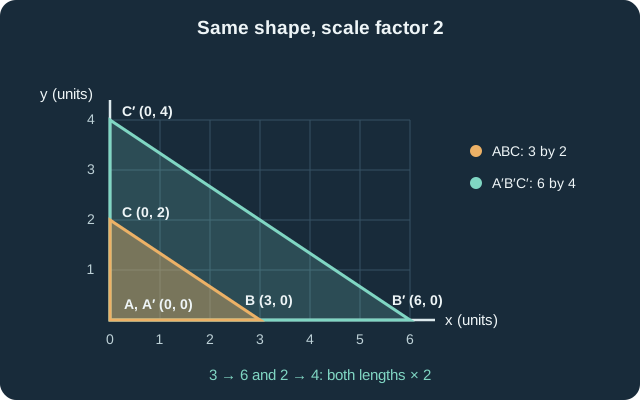
In the constructed graph below, triangle \(ABC\) has \(A=(0,0)\), \(B=(3,0)\), and \(C=(0,2)\). Its larger copy has \(A'=(0,0)\), \(B'=(6,0)\), and \(C'=(0,4)\). Each grid step represents one unit on both axes, so the two legs can be compared directly:
\[ \frac{A'B'}{AB}=\frac{6}{3}=2, \qquad \frac{A'C'}{AC}=\frac{4}{2}=2. \]
Both triangles have a right angle at the origin. Their other angles also match because doubling each coordinate keeps the slanted edge in the same direction: its vertical-to-horizontal change is \(2/3\) for the small triangle and \(4/6=2/3\) for the large one. Thus the picture represents a uniform enlargement, not a stretch.
When a missing side is given instead of a complete picture, keep the matching order. If a triangle with base 3 cm and height 2 cm is enlarged so its corresponding base is 7.5 cm, the factor is \(7.5/3=2.5\). The new height is \(2(2.5)=5\) cm. Check: \(7.5/3=5/2\), as required. Using \(3/7.5\) for the height would shrink it while the base grows.
Equal side ratios alone do not make every pair of polygons similar: their corresponding angles must match too. Conversely, angles alone do not tell you the size of a figure. In the coordinate example, the angle relationship and common side factor work together.
Reading a map scale without losing the units
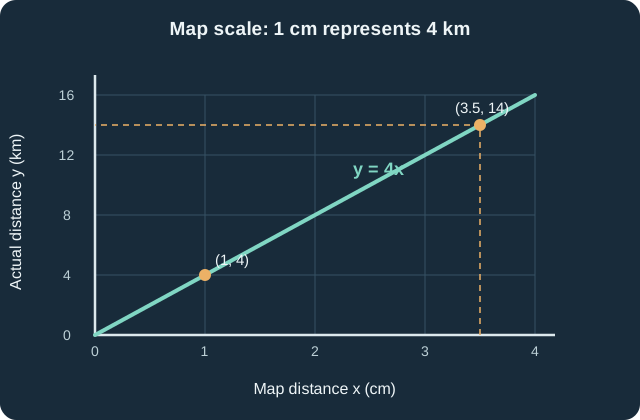
Suppose a map says 1 cm represents 4 km. Let \(x\) be a distance on the map in centimeters and \(y\) the corresponding actual distance in kilometers. The constant conversion is
\[ y=(4\text{ km/cm})x. \]
For \(x=3.5\text{ cm}\), the centimeters cancel:
\[ y=(4\text{ km/cm})(3.5\text{ cm})=14\text{ km}. \]
The graph plots this relationship as \(y=4x\) when the axes use cm and km respectively. It passes through \((0,0)\), \((1,4)\), and \((3.5,14)\). The drawn line is an exact scale model, not measurements collected from a journey. It shows map distances from 0 to 4 cm for illustration; nonnegative distances beyond that range follow the same rule if the map's scale remains uniform.
You may also see a unitless-looking ratio such as \(1:400{,}000\). It means 1 cm on the map corresponds to 400,000 cm in reality; because \(100{,}000\text{ cm}=1\text{ km}\), that is the same as 1 cm to 4 km. Writing \(1:4\) without converting the kilometers to centimeters would be wrong.
A straight segment on the map gives the corresponding straight-line distance in reality. To estimate a curving route, measure the length along the drawn route rather than using only its endpoints.
Why areas use \(k^2\), but volumes use \(k^3\)
A scale factor multiplies each length. For a rectangle of width \(w\) and height \(h\), the original area is \(A=wh\). After both lengths are multiplied by \(k\),
\[ A_{\text{copy}}=(kw)(kh)=k^2wh=k^2A_{\text{original}}. \]
For example, a \(2\text{ cm}\times3\text{ cm}\) rectangle has area \(6\text{ cm}^2\). Enlarging each side by 3 makes a \(6\text{ cm}\times9\text{ cm}\) rectangle with area \(54\text{ cm}^2=9(6\text{ cm}^2)\). Its perimeter changes from \(2(2+3)=10\text{ cm}\) to \(2(6+9)=30\text{ cm}\), only 3 times as large. Lengths and perimeters scale by \(k\); areas scale by \(k^2\).
For similar solids, three independent lengths are scaled. A rectangular prism with dimensions \(l,w,h\) has \(V=lwh\), so
\[ V_{\text{copy}}=(kl)(kw)(kh)=k^3V_{\text{original}}. \]
A \(2\text{ cm}\times3\text{ cm}\times4\text{ cm}\) prism has volume \(24\text{ cm}^3\). Scaling every dimension by 3 gives \(6\text{ cm}\times9\text{ cm}\times12\text{ cm}\), or \(648\text{ cm}^3=27(24\text{ cm}^3)\). The cube factor applies only when all three dimensions change by the same amount; changing one edge alone does not make a similar solid.
Before calculating, name what is being compared. A map distance requires a unit conversion; a missing corresponding side requires the length factor; an enlarged area or volume requires the square or cube of that factor. Check that the final unit is a length, square unit, or cubic unit as appropriate.
Further reading
The definitions of similar figures and corresponding sides were checked against OpenStax Prealgebra 2e §9.3; the map-scale proportion was checked against OpenStax Contemporary Mathematics §5.4. This lesson's prose, examples, and graphs were created independently; no textbook artwork or exercises were reproduced.