Prealgebra · Unit 3 · Topic 3.5
Multiplying and Dividing Fractions
Understand fraction multiplication with an area model and division with equal groups; use reciprocals, simplify common factors, and solve worked examples.
How do you multiply and divide fractions?
Multiply fractions by multiplying their numerators and their denominators. Divide by a nonzero fraction by multiplying by its reciprocal. Simplify the result by removing common factors. Unlike addition and subtraction, neither operation requires a common denominator.
Multiplication can answer “What is this fraction of that amount?” Division can answer “How many groups of this size fit into that amount?” These meanings help you decide which operation to use rather than memorizing a rule without context.
For numerators \(a,c\) and nonzero denominators \(b,d\),
\[\frac ab\times\frac cd=\frac{ac}{bd}.\]
For division, the divisor must also be nonzero, so \(c\ne0\):
\[\frac ab\div\frac cd=\frac ab\times\frac dc=\frac{ad}{bc}.\]
In these formulas, the letters stand for numbers. The worked examples use integer entries and write denominators as positive numbers.
Multiplication means taking a fraction of an amount
Suppose \(\frac34\) of a rectangular garden is available for planting, and \(\frac23\) of that available area is used for herbs. The herb area is \(\frac23\) of \(\frac34\) of the whole garden:
\[\frac23\times\frac34=\frac6{12}=\frac12.\]
The second fraction refers to the available area, not a separate portion of the entire garden. Half of the whole garden is used for herbs.
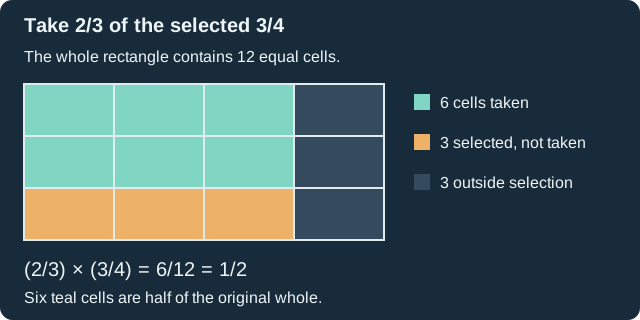
The grid explains the product rule: rows and columns create \(3\times4=12\) equal cells, while the selected overlap contains \(2\times3=6\) cells. The whole rectangle remains the reference whole throughout.
Simplify factors before or after multiplying
Both methods preserve the same value. For example,
\[\frac8{15}\times\frac9{14}=\frac{72}{210}=\frac{12}{35}.\]
To keep the numbers smaller, simplify across the product first:
- Divide the factor 8 in the numerator and the factor 14 in the denominator by 2, leaving 4 and 7.
- Divide the factor 9 in the numerator and the factor 15 in the denominator by 3, leaving 3 and 5.
Then \(\frac45\times\frac37=\frac{12}{35}\). There is no remaining common factor greater than 1.
“Canceling” does not mean deleting numbers. It means dividing the entire product's numerator and denominator by the same nonzero factor. This is valid because the numerator is a product and the denominator is a product. It is not permission to cancel separate terms across a plus or minus sign.
Reciprocals and why division uses them
The reciprocal of a nonzero number is the number that multiplies it to give 1. For \(\frac cd\), with \(c,d\ne0\), the reciprocal is \(\frac dc\), because
\[\frac cd\times\frac dc=1.\]
For example, the reciprocal of \(\frac47\) is \(\frac74\), the reciprocal of 5 is \(\frac15\), and the reciprocal of \(-\frac25\) is \(-\frac52\). Zero has no reciprocal: no number multiplied by zero equals 1.
To see why division uses the reciprocal, let \(q\) be the quotient in \(\frac ab\div\frac cd\). By the meaning of division,
\[q\times\frac cd=\frac ab.\]
Multiply both sides by \(\frac dc\). The divisor and its reciprocal multiply to 1, leaving
\[q=\frac ab\times\frac dc.\]
Only the divisor, the fraction after the division sign, is inverted. The first fraction stays unchanged.
Division means counting groups of a given size
Problem: How many \(\frac14\)-metre pieces can be cut from \(\frac34\) metre of ribbon, assuming no material is lost?
\[\frac34\div\frac14=\frac34\times4=3.\]
There are three quarter-metre pieces. Because length is divided by length, the quotient is a count of pieces, not a length in metres.
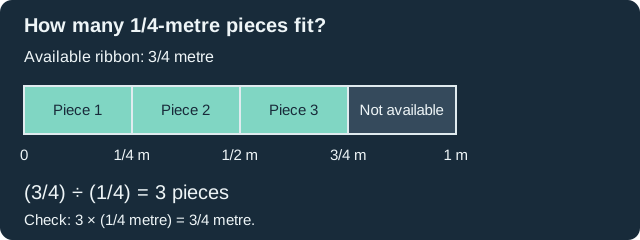
Division can also describe equal sharing. Sharing \(\frac34\) litre equally among 3 people gives \(\frac34\div3=\frac14\) litre per person. In the first problem the group size is known; in this sharing problem the number of people is known.
A reliable calculation routine
- Identify multiplication or division; do not use the addition rule.
- Convert whole numbers to fractions over 1 and mixed numbers to improper fractions.
- For division, check that the divisor is not zero, then replace division with multiplication by its reciprocal.
- Determine the sign using the signed-number rules.
- Simplify common factors in the product, multiply remaining factors, and check that the result is in simplest form.
- Check the answer's size and units. For division, multiply the quotient by the original divisor to recover the dividend.
Worked example
Problem: Compute \(\frac79\div\frac{14}{15}\).
The divisor \(\frac{14}{15}\) is nonzero. Its reciprocal is \(\frac{15}{14}\):
\[\frac79\div\frac{14}{15}=\frac79\times\frac{15}{14}.\]
Divide the numerator factor 7 and denominator factor 14 by 7, leaving 1 and 2. Divide numerator factor 15 and denominator factor 9 by 3, leaving 5 and 3:
\[\frac{1\times5}{3\times2}=\frac56.\]
Inverse check: \(\frac56\times\frac{14}{15}=\frac{70}{90}=\frac79\). Also, the quotient is slightly larger than \(\frac79\), consistent with dividing a positive number by a positive number less than 1.
Worked example: a whole number times a fraction
Problem: Find \(\frac35\) of 20 counters.
Write \(20=\frac{20}{1}\):
\[\frac35\times20=\frac{3\times20}{5\times1}=12.\]
Alternatively, divide the 20 counters into five equal groups of 4, then take three groups: \(3\times4=12\) counters. Here the multiplier is dimensionless and the result is still a count of counters.
Worked example: divide by a whole number
Problem: Share \(\frac78\) litre of juice equally among 4 cups.
Four has reciprocal \(\frac14\), so
\[\frac78\div4=\frac78\times\frac14=\frac7{32}.\]
Each cup receives \(\frac7{32}\) litre. Check: \(4\times\frac7{32}=\frac{28}{32}=\frac78\) litre in total. Multiplying by 4 instead would answer a different question.
Worked example: mixed numbers and complete pieces
Problem: How many \(\frac38\)-metre pieces fit into \(2\frac14\) metres of ribbon, with no cutting loss?
Convert \(2\frac14=\frac94\), then
\[\frac94\div\frac38=\frac94\times\frac83=6.\]
Six full pieces fit exactly. Check their total length: \(6\times\frac38=\frac{18}{8}=\frac94\) metres.
For \(2\) metres instead, the quotient would be \(2\div\frac38=\frac{16}{3}=5\frac13\). This is five and one third of a piece-sized group, not six complete pieces. You can cut five complete pieces, with \(2-5\times\frac38=\frac18\) metre left over.
Worked example: signed fractions
Problem: Evaluate \(-\frac5{12}\div\frac{10}{9}\).
The signs differ, so the answer is negative. Invert the divisor and simplify:
\[-\frac5{12}\times\frac9{10}=-\frac{1\times3}{4\times2}=-\frac38.\]
Check: \(-\frac38\times\frac{10}{9}=-\frac{30}{72}=-\frac5{12}\). If both original fractions were negative, their quotient would be positive.
Predict whether the answer grows or shrinks
For a positive starting amount:
- Multiplying by a positive number below 1 makes the amount smaller; multiplying by a number above 1 makes it larger.
- Dividing by a positive number below 1 makes the quotient larger; dividing by a number above 1 makes it smaller.
- Multiplying or dividing by 1 leaves the amount unchanged.
Thus \(\frac25\times\frac34=\frac3{10}\) is smaller than \(\frac25\), but \(\frac25\div\frac34=\frac8{15}\) is larger. “Multiplication always makes bigger” and “division always makes smaller” are not valid fraction rules. The positive-number conditions matter when making these comparisons.
Zero, order, and grouping
Zero times any defined fraction is zero. Zero divided by a nonzero fraction is also zero. Division by zero, including \(0\div0\), is undefined.
Multiplication is commutative, but division is not: \(\frac23\div\frac14=\frac83\), whereas \(\frac14\div\frac23=\frac38\).
Multiplication and division have equal priority and, without parentheses, are evaluated left to right:
\[\frac34\div\frac12\times\frac23=\frac32\times\frac23=1.\]
Parentheses can change the problem: \(\frac34\div(\frac12\times\frac23)=\frac34\div\frac13=\frac94\).
Common mistakes
- Flipping both fractions: Only invert the divisor when changing division to multiplication.
- Flipping during multiplication: \(\frac25\times\frac34=\frac6{20}\); neither fraction is inverted.
- Keeping the denominator as in addition: \(\frac27\times\frac37=\frac6{49}\), not \(\frac67\).
- Canceling across a sum: In \(\frac{2+3}{3}\), the 3 is a term of the numerator, not a factor of the entire numerator. Add first to obtain \(\frac53\).
- Reading a mixed number as a product: \(2\frac14=2+\frac14=\frac94\), not \(2\times\frac14\).
- Treating every quotient as a whole-item count: A fractional quotient may represent a partial group; decide whether only complete pieces are allowed.
- Allowing a zero divisor: Inverting a zero fraction creates a zero denominator and is not permitted.
Check your understanding
Try these before reading the answers. These lesson self-checks do not change the separate Quizzes or Practice tabs.
- Compute \(\frac35\times\frac29\).
- Simplify \(\frac{14}{25}\times\frac{15}{28}\).
- Compute \(\frac56\div\frac{10}{21}\).
- Find the reciprocals of \(-\frac79\), 6, and 1. Does 0 have one?
- Compute \(3\div\frac45\).
- Compute \(\frac56\div5\).
- Compute \(1\frac12\times\frac49\).
- Compute \(-\frac38\div(-\frac9{10})\).
- How many complete \(\frac38\)-metre pieces can be cut from \(1\frac12\) metres, with no cutting loss?
- Evaluate \(0\div\frac57\) and \(\frac57\div0\).
- Find \(\frac35\times\frac12\) and \(\frac35\div\frac12\). Explain why one shrinks and the other grows.
- Evaluate \(\frac23\div\frac45\times\frac25\) from left to right.
Answers and explanations
- \(\frac6{45}=\frac2{15}\). Multiply both pairs of entries, then divide both result entries by 3.
- \(\frac3{10}\). Simplifying 14 with 28 leaves 1 and 2; simplifying 15 with 25 leaves 3 and 5.
- \(\frac56\times\frac{21}{10}=\frac74=1\frac34\). Check: \(\frac74\times\frac{10}{21}=\frac56\).
- \(-\frac97\), \(\frac16\), and 1. Each product with the original number is 1. Zero has no reciprocal.
- \(3\times\frac54=\frac{15}{4}=3\frac34\).
- \(\frac56\times\frac15=\frac16\). Check: \(5\times\frac16=\frac56\).
- \(\frac32\times\frac49=\frac23\), after converting the mixed number.
- \(-\frac38\times(-\frac{10}{9})=\frac5{12}\). Two negative signs give a positive quotient.
- \(\frac32\div\frac38=4\) complete pieces. Their lengths total \(4\times\frac38=\frac32\) metres.
- The first result is 0; the second is undefined because its divisor is zero.
- The product is \(\frac3{10}\); the quotient is \(\frac65\). Taking half of a positive amount shrinks it; counting half-sized groups doubles the numerical amount.
- \(\frac23\times\frac54\times\frac25=\frac13\). First the division gives \(\frac56\); multiplying that by \(\frac25\) gives \(\frac13\).
Key takeaway
Multiplication can describe a fraction of an amount; division can count groups or share an amount equally. Multiply numerators and denominators for a product. For a quotient, keep the dividend and multiply by the nonzero divisor's reciprocal. Simplify only common factors, preserve signs, and check division by multiplying back.
Related lessons
- Fractions and Equivalent Forms: fraction meaning and simplification
- Greatest Common Factor and Least Common Multiple: identify common factors
- Adding and Subtracting Fractions: why those operations use a different rule
- Mixed Numbers: convert before multiplying or dividing
- Multiplying and Dividing Signed Numbers: determine the sign
- Exponents and Order of Operations: grouping and left-to-right evaluation
Sources and authorship
The public resources below were consulted for topic coverage and mathematical checks. The explanations, example settings, self-checks, and two diagrams in this lesson were independently created; textbook prose, exercise sets, and artwork are not reproduced. Public access does not mean unrestricted reuse; consult the source's current license before reproducing its material.