Prealgebra · Unit 7 · Topic 7.2
Multi-Step Linear Equations
Solve multi-step linear equations by distributing, combining like terms, and applying inverse operations; clear constant denominators or decimals and check exact solutions in the original equation.
How do you solve a multi-step linear equation?
Simplify the expressions on each side, then apply the same reversible operation to both sides until the variable is isolated. Finally, substitute the result into the original equation. More written steps do not change the equality principle used for one-step equations.
A one-variable linear equation can be written in the form \(ax+b=c\), with known real constants and \(a\ne0\), after collecting variable terms. Its variable appears to the first power, not squared or in a denominator. Equations that reduce to a zero variable coefficient need separate treatment rather than division by zero.
All examples, self-checks, and the diagram below were independently created. This lesson emphasizes simplification and inverse operations; the next lesson develops variables on both sides and special cases more fully.
Simplifying a side versus operating on both sides
Two kinds of steps occur in a solution:
| Step | What it does | Example |
|---|---|---|
| Rewrite an expression equivalently | Change its form, not its value | \(3(x+2)-4=3x+2\) |
| Apply an equality-preserving operation | Perform the same reversible operation on both sides | From \(3x+2=17\), subtract 2 on both sides |
Expanding a grouped expression on the left does not require you to expand an unrelated expression on the right. But subtracting a number from the left side requires subtracting it from the right side too.
Addition and subtraction by the same fixed value are reversible. Multiplication and division by a fixed nonzero value are reversible. Multiplying by zero can erase information; dividing by zero is undefined.
A reliable solution plan
- Distribute factors across sums and differences on each side as needed.
- Combine like terms, keeping every sign attached to its term.
- If variable terms occur on both sides, collect them on one side using the same addition or subtraction on both sides.
- Remove the constant attached to the variable term.
- Divide by its nonzero coefficient, or multiply by its reciprocal.
- Check both sides of the original equation using the exact candidate value, then check context restrictions.
You may also clear constant fraction denominators or terminating decimals first, as demonstrated below. Either route must preserve every term and the equality.
Worked example: two inverse operations
Problem: Solve \(4x+7=31\).
Subtract 7 from both sides, then divide both sides by 4:
\[4x+7-7=31-7,\qquad4x=24,\qquad x=6.\]
Check: \(4(6)+7=24+7=31\). The operation sequence building the left side is “multiply x by 4, then add 7”; the inverse sequence is “subtract 7, then divide by 4.”
Dividing first can also work if you divide the whole side: \((4x+7)/4=31/4\). It gives \(x+7/4=31/4\), not \(x+7=31/4\). Removing the added constant first is usually simpler.
Worked example: distribute, simplify, solve, and check
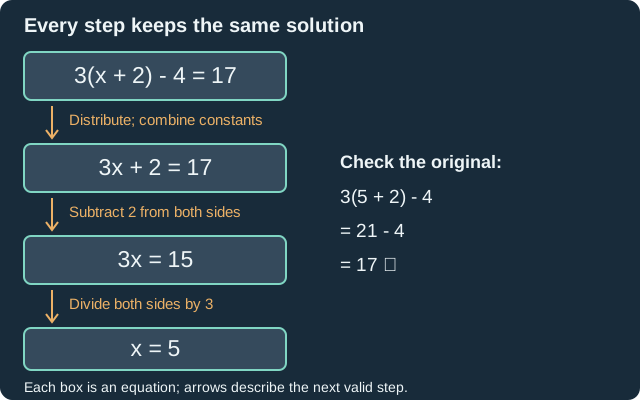
Problem: Solve \(3(x+2)-4=17\).
\[3x+6-4=17\quad\text{(distribute)},\] \[3x+2=17\quad\text{(combine constants)},\] \[3x=15\quad\text{(subtract 2 from both sides)},\] \[x=5\quad\text{(divide both sides by 3)}.\]
Check in the original: \(3(5+2)-4=21-4=17\). Therefore \(x=5\) is a solution, not merely a value that satisfies the final rewritten statement.
Worked example: negative distribution
Problem: Solve \(-2(3x-4)+5=25\).
\[-6x+8+5=25,\qquad-6x+13=25,\] \[-6x=12,\qquad x=-2.\]
The product of \(-2\) and \(-4\) is \(+8\). Subtract 13 from both sides, then divide by \(-6\).
Check: \(-2(3(-2)-4)+5=-2(-10)+5=25\). Losing either negative sign would change the equation.
Worked example: combine variable terms after expanding
Problem: Solve \(5x+2(x-3)=29\).
\[5x+2x-6=29,\qquad7x-6=29,\] \[7x=35,\qquad x=5.\]
Check: \(5(5)+2(5-3)=25+4=29\). The x terms combine by adding coefficients, not exponents.
Worked example: a grouped numerator
Problem: Solve \(\frac{x-3}{4}+2=5\).
Subtract 2 from both sides, multiply both sides by 4, then add 3:
\[\frac{x-3}{4}=3,\qquad x-3=12,\qquad x=15.\]
Check: \((15-3)/4+2=12/4+2=5\). The fraction bar groups the whole numerator. \((x-3)/4\) is not the same expression as \(x-3/4\).
Worked example: clear fractional coefficients
Problem: Solve \(\frac{x}{3}+\frac14=\frac56\).
The constant denominators 3, 4, and 6 have least common multiple 12. Multiply both entire sides by 12 and distribute to every term:
\[12\left(\frac{x}{3}+\frac14\right)=12\left(\frac56\right),\] \[4x+3=10,\qquad4x=7,\qquad x=\frac74.\]
Check: \(\frac{7/4}{3}+\frac14=\frac7{12}+\frac3{12}=\frac{10}{12}=\frac56\).
The multiplication by 12 is a reversible equation step because 12 is nonzero. Multiply the constant term too; \(12(1/4)=3\), not \(1/4\). This method uses constant denominators. A variable denominator introduces restrictions and is not covered by this simple clearing procedure.
Worked example: clear terminating decimals
Problem: Solve \(0.25x+1.2=3.45\).
Two decimal places suffice for every coefficient and constant. Multiply both sides by 100:
\[100(0.25x+1.2)=100(3.45),\] \[25x+120=345,\qquad25x=225,\qquad x=9.\]
Check: \(0.25(9)+1.2=2.25+1.2=3.45\). The whole-number coefficient x would also receive the multiplier if present; scaling only the visible decimals is not valid.
Do not round a repeating decimal coefficient into a terminating one unless an approximation is explicitly intended. Exact fraction notation avoids changing the equation.
Worked example: a fractional answer is valid
Problem: Solve \(3x+2=7\).
\[3x=5,\qquad x=\frac53.\]
Check exactly: \(3(5/3)+2=5+2=7\). A real-number solution need not be a whole number. Writing \(x\approx1.67\) is a rounded approximation, not the exact solution; substituting it gives 7.01 rather than 7.
Keep fractions through the check. If an applied problem requires a rounded measurement, state both the exact result and the requested approximation.
A preview: variables on both sides
For \(2(x+3)=x+10\), distribute first: \(2x+6=x+10\). Subtract x from both sides to get \(x+6=10\), then subtract 6 to obtain \(x=4\).
Check: the original left side is \(2(4+3)=14\), and the original right side is \(4+10=14\). Collecting variable terms is an equality-preserving operation, not a rule that a variable can simply disappear from one side.
If all variable terms cancel, inspect what remains: a true statement such as \(0=0\) allows every real x in the original domain; a false statement such as \(0=3\) allows none. Do not divide by a zero coefficient. The Variables on Both Sides and Special Cases lesson explores these outcomes further.
A quantity model with units and restrictions
Problem: A constructed workshop charge is $8 plus $3 per participant. A booking costs $35. How many participants does it cover?
Let n count participants, restricted to nonnegative whole numbers. The equation is \(3n+8=35\). Subtract 8 to get \(3n=27\), then divide by 3 to obtain \(n=9\).
Check both the equation and situation: nine participants cost \(3(9)+8=35\) dollars. If the same model gave \(n=8.5\), it would be an algebraic solution but not an allowed participant count. Do not round a count silently and claim the original equation still holds.
Diagnose an incorrect step
A student writes \(3(x+2)-4=17\), then \(3x+2-4=17\). The first incorrect step is distribution: the factor 3 must multiply the 2 as well, producing \(3x+6-4\).
Another student rewrites \(4x+7=31\) as \(4x=31\) by removing 7 only on the left. The correct step subtracts 7 from both sides, giving \(4x=24\).
When checking a solution, locate the first step that changes the condition rather than only adjusting the final answer.
Common mistakes
- Distributing to only one term: Include every signed term in the group.
- Combining unlike terms: Constants and x terms belong to different groups.
- Losing a negative factor: Divide by the complete signed coefficient.
- Operating on one side only: Apply the same reversible operation to both sides.
- Scaling only some terms: Clearing denominators or decimals multiplies the entire equation.
- Ignoring the fraction bar's grouping: Preserve the complete numerator.
- Rounding an exact solution before checking: Use fractions or exact decimals where available.
- Dividing by zero after cancellation: Inspect the remaining statement instead.
- Ignoring contextual restrictions: A numerical answer must match units and allowed quantities.
Check your understanding
Solve and check each answer in the original equation. These independently written self-checks do not change the separate Quizzes or Practice tabs.
- \(5x+4=24\).
- \(7-2x=15\).
- \(4(x-2)+3=19\).
- \(-3(x+2)+5=14\).
- \(2x+3(x-1)=22\).
- \((x+1)/3-2=4\).
- \(x/4+1/3=5/6\).
- \(0.2x+0.75=2.15\).
- \(6x-1=4\). Keep the answer exact.
- \(3(x+1)=2x+8\).
- A hypothetical hire charge is $6 plus $4 per hour. Write and solve an equation for a $30 charge.
- A student simplifies \(2(x-3)+4=12\) to \(2x-3+4=12\). Identify the error and solve correctly.
Answers and original-equation checks
- \(5x=20\), so \(x=4\). Check: \(5(4)+4=24\).
- \(-2x=8\), so \(x=-4\). Check: \(7-2(-4)=15\).
- \(4x-8+3=19\), so \(4x=24\) and \(x=6\). Check: \(4(6-2)+3=19\).
- \(-3x-6+5=14\), so \(-3x=15\) and \(x=-5\). Check: \(-3(-5+2)+5=14\).
- \(5x-3=22\), so \(x=5\). Check: \(2(5)+3(5-1)=22\).
- \((x+1)/3=6\), so \(x+1=18\) and \(x=17\). Check: \((17+1)/3-2=4\).
- Multiply by 12: \(3x+4=10\), so \(x=2\). Check: \(2/4+1/3=1/2+1/3=5/6\).
- Multiply by 100: \(20x+75=215\), so \(x=7\). Check: \(0.2(7)+0.75=2.15\).
- \(6x=5\), so \(x=5/6\). Check: \(6(5/6)-1=4\).
- \(3x+3=2x+8\), so \(x=5\). Check: \(3(5+1)=18=2(5)+8\).
- Let h be hours. \(4h+6=30\), so \(h=6\) hours. Check: \(4(6)+6=30\) dollars.
- The 2 must multiply −3, giving −6. Correctly: \(2x-6+4=12\), so \(2x=14\) and \(x=7\). Check: \(2(7-3)+4=12\).
Key takeaway
Simplify each side without changing its value, then isolate the variable using the same reversible operations on both sides. Preserve signs and grouping, multiply every term when clearing constant denominators or decimals, and avoid division by zero. Check the exact answer in the original equation and in any stated context.
Related lessons
- One-Step Equations and Checking Solutions: inverse operations and substitution
- The Distributive Property: expand complete signed groups
- Combining Like Terms and Classifying Numbers: simplify each side
- Greatest Common Factor and Least Common Multiple: choose a common denominator
- Variables on Both Sides and Special Cases: classify solution outcomes
- Building Equations from Word Problems: check units and restrictions
Sources and authorship
The publicly accessible educational resources below were consulted for topic coverage and mathematical checks. This lesson's explanations, example settings, tables, self-checks, and solution-flow diagram were independently created; source prose, exercises, and artwork are not reproduced. Public access does not imply unrestricted reuse: check each resource's current license before reproducing material.