Prealgebra · Unit 6 · Topic 6.2
Translating Words into Expressions
Translate word phrases and quantity models into algebraic expressions by defining variables, preserving subtraction and division order, and grouping sums, differences, and powers correctly.
How do you translate words into an algebraic expression?
Define the quantity represented by each variable, identify the operations, and preserve their order and grouping. An expression should describe the quantity named in the sentence, not just contain symbols suggested by individual keywords.
For example, “three times the sum of a number and five” becomes \(3(x+5)\), where \(x\) represents the number. Add five to the number first, then multiply that entire sum by three.
This lesson develops translation rather than equation solving. All situations and practice questions below are independently constructed teaching examples.
A five-step translation routine
- Name the quantity: Write “Let \(x\) represent …,” including units and restrictions if relevant.
- Find the parts: Identify which quantities are being added, removed, multiplied, or divided.
- Find the outer operation: Ask what happens to the complete inner quantity.
- Write grouping explicitly: Use parentheses or a fraction bar when an operation acts on a whole sum or difference.
- Read back and check: Describe your expression in words; use a simple allowed value to detect a reversed operation or missing group.
A numerical test can reveal a mistake, but agreement at one value does not establish that two expressions are equivalent for every value. The meaning of the original phrase remains the main check.
Operation vocabulary: use meaning, not keywords alone
In the table, \(x\) denotes a number. Different expressions can describe the same quantity, but subtraction and division need particular care.
| Phrase | Expression | Reading check |
|---|---|---|
| A number increased by eight | \(x+8\) | Start with the number; add eight |
| Eight added to a number | \(x+8\) | The two quantities form a sum |
| A number decreased by eight | \(x-8\) | Remove eight from the number |
| Eight subtracted from a number | \(x-8\) | The number is the starting amount |
| The difference of eight and a number | \(8-x\) | In this ordered phrase, subtract the second from the first |
| The product of six and a number | \(6x\) | Multiply six by the number |
| The quotient of a number and six | \(x/6\) | The number is the dividend |
| Six divided by a number | \(6/x\) | The number is the divisor; \(x\ne0\) |
| The square of a number | \(x^2\) | Multiply the number by itself |
“Of” indicates multiplication in phrases such as “one quarter of a number,” giving \(\frac14x\). But not every occurrence of “of” in ordinary prose is an instruction to multiply. Read the complete quantity being described.
Worked example: less than and subtracted from
Problem: Translate “five less than a number” and “a number subtracted from five.”
Let \(x\) be the number. “Five less than a number” starts with \(x\) and removes 5, giving \(x-5\). “A number subtracted from five” starts with 5 and removes \(x\), giving \(5-x\).
Check with \(x=12\): five less than 12 is 7, but 12 subtracted from five is \(-7\). The expressions are not interchangeable.
In a translation exercise, “a number less than five” may be used to mean the amount \(5-x\). In ordinary language it can instead describe a number satisfying \(x<5\). Distinguish an amount to calculate from a comparison to assert; if the intended meaning is unclear, clarify it rather than guessing from a keyword.
Worked example: division order
Problem: Translate “a number divided by four” and “four divided by a number.”
The first is \(x/4\). The second is \(4/x\), requiring \(x\ne0\). At \(x=8\), their values are 2 and \(\frac12\), respectively.
Addition and multiplication can swap their two inputs without changing a numerical result. Subtraction and division generally cannot: \(8-4\ne4-8\), and \(8/4\ne4/8\).
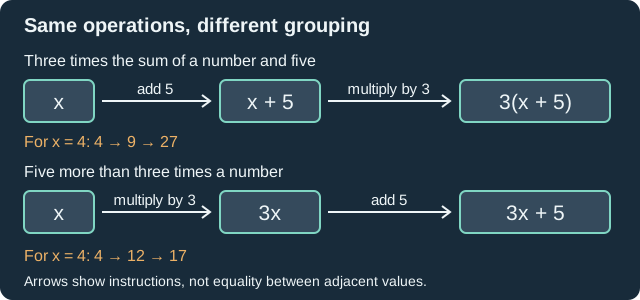
Worked example: multiply a sum or add after multiplying?
Problem: Compare these phrases:
- “Three times the sum of a number and five”: \(3(x+5)\).
- “Five more than three times a number”: \(3x+5\).
The first groups \(x+5\) before multiplication. The second multiplies \(x\) first, then adds five. When \(x=4\), the values are \(3(4+5)=27\) and \(3(4)+5=17\).
Worked example: divide an entire difference
Problem: Translate “the difference of a number and seven, divided by three.”
The difference is \(x-7\). Divide that complete quantity by 3:
\[\frac{x-7}{3}.\]
At \(x=19\), this is \((19-7)/3=4\). Without grouping, \(x-7/3\) means subtract one third of seven from \(x\), which is a different calculation. A fraction bar groups its entire numerator and denominator.
Similarly, “ten divided by the sum of a number and two” is \(\frac{10}{x+2}\), requiring \(x\ne-2\). The restriction applies to the whole denominator, not just to \(x\) being nonzero.
Worked example: powers and nested grouping
Problem: Compare “the square of the sum of a number and two” with “two more than the square of a number.”
The expressions are \((x+2)^2\) and \(x^2+2\). For \(x=3\), they give \(5^2=25\) and \(9+2=11\). Squaring the whole sum is not the same as squaring just the number.
For “four times the square of the difference of a number and one,” build the expression from inside outward:
\[x-1\quad\longrightarrow\quad(x-1)^2\quad\longrightarrow\quad4(x-1)^2.\]
At \(x=3\), the result is \(4(3-1)^2=16\). The 4 multiplies the squared difference; it is not inside the square.
Worked example: a cost model with units
Problem: A workshop charges a fixed $7 booking fee plus $3 per participant. Write the total charge for \(n\) participants and evaluate it for 8 participants.
Let \(n\) be the participant count, a nonnegative whole number within the workshop's capacity. The dollar-cost expression is \(3n+7\): the per-participant charge depends on \(n\), while the booking fee is added once.
For \(n=8\), \(3(8)+7=31\), so the charge is $31. Writing \(3(n+7)\) would charge the booking fee three times. Whether a booking with zero participants is allowed is a separate condition of this constructed model.
The units support the expression: dollars per participant multiplied by participants gives dollars, which can be added to the dollar booking fee.
Worked example: two quantities and a remaining amount
Problem: A shelf initially has \(b\) books. Then \(a\) books are added and \(r\) books are removed. Write the remaining count.
The expression is \(b+a-r\). Here all three variables count books; require nonnegative whole numbers and \(r\le b+a\) if the removed books must be available.
For \(b=24\), \(a=6\), and \(r=9\), the count is \(24+6-9=21\). The condition prevents a negative final count from an impossible removal in this model.
Worked example: a percent of a quantity versus a percent increase
Let \(p\) be an original price in dollars. “Twenty percent of the price” is \(0.20p\); “the price increased by twenty percent” is \(p+0.20p=1.20p\).
At \(p=50\), these give $10 and $60. The first describes the additional amount alone; the second describes the new total. Define which quantity the question asks for before writing the expression.
When words describe an equation or inequality instead
“Six more than twice a number” gives the expression \(2x+6\). Adding “equals eighteen” gives the equation \(2x+6=18\). Adding “is at most eighteen” gives \(2x+6\le18\).
Do not add an equals sign and invent a target value when only an expression is requested. Conversely, preserve a comparison when a complete statement explicitly supplies one. An equals sign means the two sides have the same value; it is not an instruction to proceed to the next operation.
Common mistakes
- Copying the order of words blindly: “Five less than x” starts with x, not five.
- Reversing the divisor and dividend: \(x/4\) and \(4/x\) generally differ.
- Dropping the whole group: A multiple of a sum needs parentheses around that sum.
- Squaring only one part of a sum: \((x+2)^2\) and \(x^2+2\) differ.
- Confusing a part with a new total: A 20% increase adds the original amount to the 20% portion.
- Leaving variables undefined: State the quantity and units each letter represents.
- Ignoring restrictions: Counts cannot be negative, and a denominator cannot be zero.
- Relying only on keywords: Ambiguous ordinary-language phrases need context or clarification.
Check your understanding
Translate before evaluating. These self-checks do not alter the separate Quizzes or Practice tabs.
- Write “eleven more than a number,” using \(x\).
- Write “eleven less than a number.”
- Write “a number subtracted from eleven.”
- Write “the quotient of a number and five,” then evaluate at \(x=20\).
- Write “five divided by a number,” then evaluate at \(x=20\). State the restriction.
- Write “twice the sum of a number and nine,” then evaluate at \(x=3\).
- Write “nine more than twice a number,” then evaluate at \(x=3\).
- Write “the difference of a number and four, divided by six,” then evaluate at \(x=22\).
- Write “the square of the difference of a number and three,” then evaluate at \(x=7\).
- A hypothetical delivery costs $5 plus $2 per package. Write the dollar-cost expression for \(n\) packages and evaluate at \(n=6\).
- Write “twelve divided by the sum of a number and four.” State the restriction and evaluate at \(x=2\).
- A length \(\ell\) centimeters increases by 15%. Write an expression for the new length and evaluate at \(\ell=40\).
Answers and explanations
- \(x+11\): add eleven to the number.
- \(x-11\): remove eleven from the number.
- \(11-x\): start with eleven and subtract the number.
- \(x/5\); at \(x=20\), the value is 4.
- \(5/x\), with \(x\ne0\); at \(x=20\), the value is \(1/4\).
- \(2(x+9)\); at \(x=3\), \(2(12)=24\).
- \(2x+9\); at \(x=3\), \(6+9=15\).
- \((x-4)/6\); at \(x=22\), \(18/6=3\).
- \((x-3)^2\); at \(x=7\), \(4^2=16\).
- \(2n+5\); at \(n=6\), the delivery cost is $17.
- \(12/(x+4)\), with \(x\ne-4\); at \(x=2\), \(12/6=2\).
- \(\ell+0.15\ell=1.15\ell\); at \(\ell=40\), the new length is 46 cm.
Key takeaway
Translate the meaning of the whole phrase: define variables, identify inner groups and outer operations, preserve subtraction and division order, and state restrictions. Read your expression back in words and check a simple allowed value. Use an equation or inequality only when the statement actually asserts a comparison.
Related lessons
- Variables and Algebraic Expressions: notation, substitution, and allowed values
- Exponents and Order of Operations: understand grouping
- The Distributive Property: rewrite a multiple of a sum
- Combining Like Terms and Classifying Numbers: simplify translated expressions
- Percent Increase and Decrease: distinguish a change from a new total
Sources and authorship
The publicly accessible educational resources below were consulted for topic coverage and mathematical checks. This lesson's explanations, example settings, tables, self-checks, and operation-flow diagram were independently created; source prose, exercises, and artwork are not reproduced. Public access does not imply unrestricted reuse: check each resource's current license before reproducing material.