Prealgebra · Unit 5 · Topic 5.2
Equivalent Ratios and Proportions
Recognize equivalent ratios, solve proportions by scaling, unit rates, and cross products, and check constant-ratio assumptions in recipes, prices, and scale drawings.
What are equivalent ratios and proportions?
Equivalent ratios describe the same relative amounts. A proportion is an equation stating that two ratios are equal. For example, \(3:5\) and \(12:20\) are equivalent, so \(\frac35=\frac{12}{20}\) is a true proportion.
To find a missing quantity, you can scale both ratio entries by the same factor, find a unit rate, or solve an equation using cross products. First check that the situation actually supports the constant ratio you are using.
This lesson explains why those methods work, how to keep quantities in the correct order, and how to check answers in the original relationship.
Equivalent ratios scale both entries together
For \(b\ne0\) and \(k\ne0\),
\[\frac ab=\frac{ka}{kb}.\]
Multiplying the numerator and denominator by \(k\) multiplies the fraction by \(\frac kk=1\), so its value stays unchanged. In the nonnegative measurement examples here, use a positive scale factor.
For instance, \(3:5=6:10=12:20\). Dividing \(12:20\) by the common factor 4 recovers \(3:5\). Adding the same number to both entries is different: \(3:5\) and \(6:8\) are not equivalent, because \(\frac35\ne\frac68\).
Keep corresponding quantities in the same positions
Suppose 3 cups of oats make 8 servings, and you want the amount needed for 20 servings of the same size. Let \(x\) be the number of cups.
| Batch | Oats, in cups | Servings |
|---|---|---|
| Original | 3 | 8 |
| Scaled | \(x\) | 20 |
Use cups per serving on both sides:
\[\frac{3\text{ cups}}{8\text{ servings}}=\frac{x\text{ cups}}{20\text{ servings}}.\]
Alternatively, use servings per cup on both sides: \(\frac83=\frac{20}{x}\), with \(x\ne0\). Do not reverse only one ratio. Labels make it easier to see the correspondence before substituting numbers.
Why cross products are equal
For nonzero denominators \(b,d\),
\[\frac ab=\frac cd\quad\text{if and only if}\quad ad=bc.\]
To derive this, multiply both sides of \(\frac ab=\frac cd\) by \(bd\). The denominators cancel, leaving \(ad=bc\). Conversely, dividing \(ad=bc\) by the same nonzero \(bd\) recovers the original equality.
Cross multiplication is an equation-solving consequence, not a rule for multiplying or adding fractions. If a variable appears in a denominator, record that it cannot be zero and check that restriction afterward.
Worked example: test whether ratios are equivalent
Problem: Are \(8:14\) and \(20:35\) equivalent? What about \(8:14\) and \(20:36\)?
The first pair has equal cross products: \(8\times35=280\) and \(14\times20=280\). Both also simplify to \(4:7\).
For the second pair, \(8\times36=288\), but \(14\times20=280\). The cross products differ, so those ratios are not equivalent. Similar-looking numbers are not enough.
Worked example
Problem: Four identical notebooks cost 10 dollars. What do seven cost at the same price per notebook, with no fixed fee or quantity discount?
Let \(x\) be the cost in dollars. Keep dollars over notebooks on both sides:
\[\frac{x}{7}=\frac{10}{4}.\]
Three methods give the same answer:
- Unit rate: \(10\div4=2.50\) dollars per notebook, then \(7\times2.50=17.50\) dollars.
- Scale factor: The quantity increases by \(\frac74\), so cost increases by the same factor: \(10\times\frac74=17.50\).
- Cross products: \(4x=7\times10=70\), so \(x=70\div4=17.50\).
Check: \(\frac{17.50}{7}=2.50=\frac{10}{4}\). The answer should exceed 10 dollars because seven notebooks exceed four. These prices are invented for the example, not current retail prices.
See equivalent pairs on a double number line
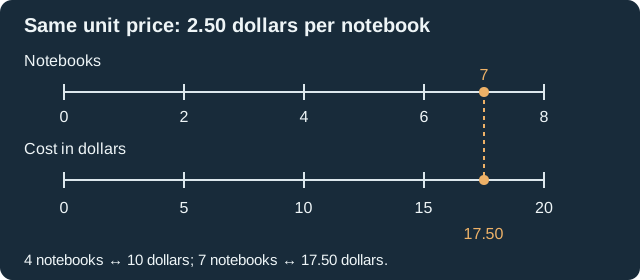
The paired values keep the same cost per notebook. The zeros represent no notebooks and no cost under this model; do not divide the zero pair to compute a rate, because \(0\div0\) is undefined.
Worked example: a recipe uses a noninteger scale factor
Problem: Find the oats needed for 20 servings when 3 cups make 8 servings.
Assume the recipe scales linearly and serving size stays fixed. The number of servings is multiplied by \(20\div8=2.5\), so the oats are multiplied by 2.5:
\[x=3\times2.5=7.5\text{ cups}.\]
Using the proportion instead gives \(8x=3\times20=60\), hence \(x=7.5\). Check: \(7.5\div20=0.375\) cup per serving, equal to \(3\div8\). A scale factor does not have to be a whole number.
Worked example: the unknown is in the denominator
Problem: Solve \(\frac{18}{x}=\frac32\).
First require \(x\ne0\). Cross multiply:
\[18\times2=3x,\qquad36=3x,\qquad x=12.\]
Check in the original equation: \(\frac{18}{12}=\frac32\), and 12 is not zero. Do not invert only one side or drop the denominator restriction.
Worked example: decimal ratios
Problem: At a constant pumping rate, 2.4 litres are delivered in 3 minutes. How long does 6 litres take?
Let \(t\) be time in minutes and use litres per minute on both sides:
\[\frac{2.4}{3}=\frac6t,\qquad2.4t=18,\qquad t=7.5.\]
It takes 7.5 minutes. The unit rate is \(2.4\div3=0.8\) litre per minute, and \(0.8\times7.5=6\) litres, which checks the result. The prediction assumes the pump's rate remains unchanged.
Worked example: a scale drawing
Problem: A map uses the scale 1 centimetre to 250 metres. A route measures 3.6 centimetres on the map. Find the represented distance.
Keep real distance over map distance:
\[\frac{250\text{ m}}{1\text{ cm on map}}=\frac{D\text{ m}}{3.6\text{ cm on map}},\qquad D=900.\]
The route represents 900 metres, or 0.9 kilometre. The map and ground distances are corresponding lengths in different settings.
If expressing the scale as a dimensionless length ratio, first match units: 250 metres is 25,000 centimetres, so the map-to-ground scale is \(1:25{,}000\), not \(1:250\). The labeled statement “1 cm represents 250 m” is still valid.
Worked example: a total split in a fixed ratio
Problem: A mixture has concentrate:water ratio \(2:5\) and total volume 21 litres. Find each amount, assuming the recipe volumes add.
There are \(2+5=7\) equal ratio parts, each representing \(21\div7=3\) litres. Concentrate is 6 litres and water is 15 litres.
As a proportion, concentrate:total is \(2:7\), so \(\frac c{21}=\frac27\) gives \(c=6\). Check: \(6+15=21\) and \(\frac6{15}=\frac25\). Using \(\frac c{21}=\frac25\) would confuse part-to-part with part-to-whole.
Recognize a directly proportional relationship
Two quantities \(x,y\) are directly proportional when \(y=kx\) for a fixed constant \(k\). For \(x\ne0\), \(\frac yx=k\). Here \(k\) is the constant of proportionality, with units when the quantities require them.
For the notebook model, \(C=2.5n\), where \(C\) is cost in dollars and \(n\) is notebook count:
| Notebooks \(n\) | Cost \(C\), in dollars | Cost per notebook for \(n>0\) |
|---|---|---|
| 0 | 0 | Undefined as \(0/0\) |
| 2 | 5 | 2.50 |
| 4 | 10 | 2.50 |
| 6 | 15 | 2.50 |
Positive-input ratios stay constant, and multiplying the quantity by a factor multiplies the output by the same factor. A direct-proportion graph lies on a straight line through the origin; a situation with whole-item inputs may use only discrete points on that line.
When a proportion is the wrong model
Fixed fees: Suppose delivery costs a 3-dollar fee plus 2.50 dollars per notebook. Four notebooks cost 13 dollars, but seven cost \(3+2.5\times7=20.50\) dollars. A proportion based on \(13/4\) would wrongly predict 22.75 dollars. Total cost is not directly proportional to notebook count.
Both increasing is not enough: For a square, side length \(s\) and area \(A=s^2\) both increase, but doubling the side quadruples area. Their ratio is not constant.
Inverse relationships are different: Sharing a fixed 24-dollar bill among \(n>0\) people gives cost per person \(p=24/n\). Doubling the number of people halves the cost per person. The product \(np=24\) is constant, not the quotient \(p/n\). Do not treat this as direct proportion.
Cross products can solve a correctly written equality; they cannot establish that an inappropriate real-world assumption is true.
Common mistakes
- Scaling only one entry: Equivalent ratios scale both quantities together.
- Adding the same amount to both entries: Equal increases generally do not preserve a ratio.
- Reversing only one ratio: Keep corresponding quantities consistently in the numerator and denominator.
- Forgetting units: Match measurement units before using a dimensionless ratio.
- Using a part-to-part ratio as a part-to-whole fraction: Add all ratio parts when the given number is a total.
- Ignoring denominator restrictions: An unknown denominator cannot be zero.
- Assuming all growing quantities are proportional: Check a constant ratio, fixed fees, and the stated context.
- Skipping the final check: Substitute into the original equation and state the answer with its unit.
Check your understanding
Try these before reading the explanations. These lesson self-checks do not modify the separate Quizzes or Practice tabs.
- Write two ratios equivalent to \(4:9\).
- Are \(10:16\) and \(15:24\) equivalent?
- Solve \(\frac{x}{35}=\frac25\).
- Solve \(\frac7{12}=\frac{21}{y}\), stating the denominator restriction.
- Solve \(\frac{1.5}{4}=\frac z{10}\).
- Five identical markers cost 8 dollars at a constant unit price. Find the cost of 12, with no extra fee.
- A recipe uses 4 cups for 10 servings. How many cups make 15 equal-size servings?
- On a map, 1 cm represents 400 m. What distance does 2.75 cm represent?
- A mixture has juice:water ratio \(3:4\) and total volume 28 litres. Find each volume.
- A table pairs \(x=2,4,6\) with \(y=7,14,21\). Find \(k\) for the direct-proportion model and predict \(y\) when \(x=10\).
- A service charges 5 dollars plus 2 dollars per item. Is total cost directly proportional to item count?
- A 30-dollar bill is shared equally. Compare the cost per person for 3 people and 6 people. Is this direct proportion?
Answers and explanations
- For example, \(8:18\) and \(12:27\), scaling both entries by 2 and 3.
- Yes. Both simplify to \(5:8\), and \(10\times24=16\times15=240\).
- \(x=35\times\frac25=14\); check \(\frac{14}{35}=\frac25\).
- Require \(y\ne0\). Then \(7y=12\times21=252\), so \(y=36\).
- \(4z=15\), so \(z=3.75\). Both ratios equal 0.375.
- \(8\div5=1.60\) dollars per marker; 12 cost 19.20 dollars.
- \(4\times\frac{15}{10}=6\) cups.
- \(2.75\times400=1100\) metres, or 1.1 kilometres.
- Seven parts give 4 litres per part; juice is 12 litres and water is 16 litres.
- \(k=7/2=3.5\), and \(y=3.5\times10=35\), assuming the same model extends to that input.
- No. One item costs 7 dollars and two cost 9 dollars, so the cost per item changes. The rule is \(C=5+2n\), not \(C=kn\).
- 10 dollars per person versus 5 dollars per person. The relationship is inverse: \(np=30\), not a constant \(p/n\).
Key takeaway
Equivalent ratios preserve a comparison by scaling both entries together. A proportion equates those ratios; multiplying by nonzero denominators gives equal cross products. Solve using scaling, unit rates, or an equation, then check the original relationship. Apply direct-proportion reasoning only when a constant ratio and the context support it.
Related lessons
Sources and authorship
Public educational resources were consulted for topic coverage and mathematical checks. The explanations, application settings, self-checks, tables, and diagram here were independently created; source prose, exercise sets, and artwork are not reproduced. Public access does not imply unrestricted reuse: consult each source's current licensing terms before reproducing material.