Prealgebra · Unit 7 · Topic 7.1
One-Step Equations and Checking Solutions
Solve one-step equations by applying inverse operations to both sides; handle signed, fractional, and decimal values, and verify each solution in the original equation.
What is a one-step equation, and what is a solution?
A one-step equation can be solved by applying one inverse operation to both sides to isolate its variable. A solution is a value that makes the original equation's two sides equal. For example, \(x+4=11\) becomes \(x=7\) after subtracting 4 from both sides.
The equals sign asserts equality, not “do the next calculation.” The expression \(x+4\) alone describes a value; the equation \(x+4=11\) supplies a condition on that value.
This lesson works with real-number solutions unless a context restricts them. All example situations, self-checks, and the diagram below were independently created.
Why the same operation must be applied to both sides
For real numbers A and B with \(A=B\), the following are true:
| Operation on both sides | Result | Condition for a reversible solving step |
|---|---|---|
| Add c | \(A+c=B+c\) | Any real constant c |
| Subtract c | \(A-c=B-c\) | Any real constant c |
| Multiply by c | \(cA=cB\) | Use \(c\ne0\) to preserve the solution set |
| Divide by c | \(A/c=B/c\) | Requires \(c\ne0\) |
Adding a fixed quantity can be undone by subtracting it. Multiplying by a nonzero constant can be undone by dividing by it. These reversible steps produce equivalent equations, with the same solutions.
Multiplying both sides by zero makes \(0=0\) regardless of their earlier values, so it can erase the original condition. Dividing by zero is undefined. Neither is a valid way to isolate a variable while preserving the solution set.
See an equality-preserving step
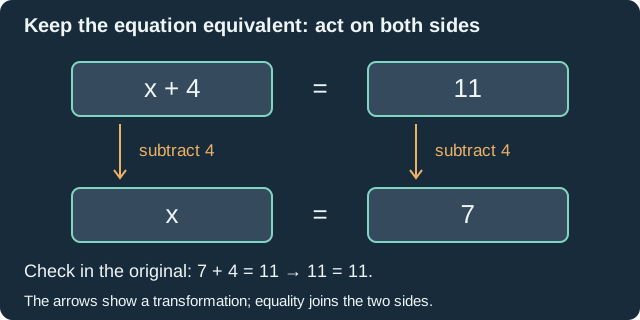
Subtracting 4 only on the left would produce \(x=11\), which does not solve the original equation: \(11+4=15\ne11\). Both sides must receive the same operation.
Choose the inverse operation
Here a and b are known real constants:
| Equation form | Operation on both sides | Solution |
|---|---|---|
| \(x+a=b\) | Subtract a | \(x=b-a\) |
| \(x-a=b\) | Add a | \(x=b+a\) |
| \(ax=b\), \(a\ne0\) | Divide by a | \(x=b/a\) |
| \(x/a=b\), \(a\ne0\) | Multiply by a | \(x=ab\) |
Choose from the operation acting on the variable, not merely the sign of the right-hand number. In \(-4x=20\), the variable is multiplied by \(-4\), so divide both sides by \(-4\).
“Move the number and change its sign” can hide the reasoning. Write the operation on both sides first; cancellation explains the result.
A solve-and-check routine
- Identify the variable and the operation acting on it.
- Apply the inverse operation to both complete sides.
- Simplify to isolate the variable. Write the answer as \(x=\text{value}\), not just a bare number.
- Substitute that value into the original equation.
- Calculate the left and right sides separately and confirm they match. Check units and context restrictions too.
One-step refers to the equation transformation; arithmetic and the final check may require several written lines.
Worked example: undo addition
Problem: Solve \(x+9=-5\).
\[x+9-9=-5-9,\qquad x=-14.\]
Check in the original: \(-14+9=-5\), equal to the right side. The solution is \(x=-14\). Adding 9 again would not undo the addition already attached to x.
Worked example: undo subtraction
Problem: Solve \(y-8=-3\).
\[y-8+8=-3+8,\qquad y=5.\]
Check: \(5-8=-3\). Add 8 to undo subtracting 8; do not subtract 8 from both sides again.
Be careful with signed constants: \(x-(-4)=9\) is \(x+4=9\). Subtracting 4 from both sides gives \(x=5\), checked by \(5-(-4)=9\).
Worked example: undo multiplication with a negative coefficient
Problem: Solve \(-4x=20\).
\[\frac{-4x}{-4}=\frac{20}{-4},\qquad x=-5.\]
Check: \((-4)(-5)=20\). The negative coefficient must be included in the divisor. In \(-x=6\), the coefficient is \(-1\); dividing by \(-1\) gives \(x=-6\).
Worked example: undo division
Problem: Solve \(x/6=-4\).
Multiply each side by 6:
\[6\left(\frac{x}{6}\right)=6(-4),\qquad x=-24.\]
Check: \(-24/6=-4\). The divisor 6 is nonzero, so multiplication by 6 reverses this division.
This rule describes a constant denominator. An equation such as \(6/x=3\) has the variable in the denominator and also requires \(x\ne0\); it is not the same form as \(x/6=3\).
Worked example: a fractional coefficient
Problem: Solve \(\frac23x=10\).
Multiply both sides by the reciprocal \(\frac32\):
\[\frac32\cdot\frac23x=10\cdot\frac32,\qquad x=15.\]
The coefficient product is 1, so only x remains. Check: \(\frac23\cdot15=10\). Multiplying by \(\frac23\) again would not undo the original multiplication.
For a negative coefficient, \(-\frac23x=10\) instead gives \(x=-15\), using reciprocal \(-\frac32\). Check: \((-\frac23)(-15)=10\).
Worked example: adding a fraction to both sides
Problem: Solve \(y-\frac5{12}=\frac14\).
\[y=\frac14+\frac5{12}=\frac3{12}+\frac5{12}=\frac8{12}=\frac23.\]
The first line adds \(5/12\) to both sides; then a common denominator makes the arithmetic possible. Check: \(\frac23-\frac5{12}=\frac8{12}-\frac5{12}=\frac3{12}=\frac14\).
Worked example: a decimal coefficient
Problem: Solve \(0.4x=3.6\).
\[x=\frac{3.6}{0.4}=9.\]
Divide both sides by 0.4, not by 4. Check: \(0.4(9)=3.6\). Keep exact decimals or fractions during the solution whenever possible rather than rounding a candidate before checking it.
Checking a proposed value without solving first
Problem: Determine whether 6 or 7 is a solution of \(3x=21\).
For \(x=6\), the left side is \(3(6)=18\), while the right side is 21. Since \(18\ne21\), 6 is not a solution.
For \(x=7\), the left side is \(3(7)=21\), matching the right side. Therefore 7 is a solution. Checking tests a supplied value; solving finds the value from the equation.
Do not check only the rewritten final statement \(x=7\). A copied sign or arithmetic error earlier could give a wrong candidate that still satisfies that final statement. Return to the original condition.
Worked example: the variable on the right
Problem: Solve \(18=3n\).
Divide both sides by 3: \(18/3=3n/3\), so \(6=n\), equivalently \(n=6\). Equality works in either direction.
Check in the original: \(18=3(6)=18\). The variable need not begin on the left for an equation to be solved.
A one-step quantity model
Problem: Four identical packets contain 36 cards in total. How many cards are in each packet?
Let n be the number of cards per packet, a nonnegative whole number. Then \(4n=36\), so \(n=36/4=9\).
Check the situation: four packets with nine cards each contain 36 cards. The answer is 9 cards per packet, not just 9 with no quantity identified. If a count problem produced a noninteger answer, check whether the stated assumptions allow such a count.
A zero coefficient is a special case
The formula \(x=b/a\) for \(ax=b\) requires \(a\ne0\). If the coefficient is zero, inspect the resulting statement instead:
- \(0x=0\) is true for every real x: all real numbers are solutions.
- \(0x=5\) is false for every real x: there is no solution.
Do not divide either equation by zero. The usual nonzero-coefficient one-step equations in this lesson have a unique real solution; these degenerate cases do not.
Common mistakes
- Operating on only one side: Apply the same inverse operation to both complete sides.
- Undoing subtraction with subtraction: Use addition to undo subtraction.
- Dropping a negative coefficient: Divide by the whole signed coefficient.
- Confusing addition with multiplication: \(x+4\) needs subtraction; \(4x\) needs division.
- Using the same fraction instead of its reciprocal: To undo multiplication by \(2/3\), multiply by \(3/2\).
- Losing decimal scale: Dividing by 0.4 is different from dividing by 4.
- Treating zero as a permitted divisor: Check the nonzero condition before dividing.
- Checking only the final rewritten equation: Substitute into the original equation and compare both sides.
- Ignoring the meaning of the variable: A real-number solution may fail a counting or measurement restriction.
Check your understanding
Solve and check each answer in the original equation. These self-checks do not modify the separate Quizzes or Practice tabs.
- \(x+7=-2\).
- \(y-6=-10\).
- \(-5a=30\).
- \(b/8=-3\).
- \(\frac34c=9\).
- \(d-\frac23=\frac16\).
- \(0.25m=2.5\).
- \(-n=11\).
- \(28=4p\).
- Is \(q=5\) a solution of \(q+9=15\)? Find the actual solution.
- Five identical boxes hold 45 pencils. Define a variable, write a one-step equation, and solve.
- Compare the solution sets of \(0x=0\) and \(0x=-2\).
Answers and checks
- Subtract 7: \(x=-9\). Check: \(-9+7=-2\).
- Add 6: \(y=-4\). Check: \(-4-6=-10\).
- Divide by \(-5\): \(a=-6\). Check: \((-5)(-6)=30\).
- Multiply by 8: \(b=-24\). Check: \(-24/8=-3\).
- Multiply by \(4/3\): \(c=12\). Check: \(\frac34(12)=9\).
- Add \(2/3\): \(d=\frac16+\frac46=\frac56\). Check: \(\frac56-\frac46=\frac16\).
- Divide by 0.25: \(m=10\). Check: \(0.25(10)=2.5\).
- Divide by \(-1\): \(n=-11\). Check: \(-(-11)=11\).
- Divide both sides by 4: \(p=7\). Check: \(28=4(7)\).
- No: \(5+9=14\ne15\). The solution is \(q=6\), checked by \(6+9=15\).
- Let k count pencils per box. \(5k=45\), so \(k=9\) pencils per box. Check: \(5(9)=45\).
- \(0x=0\) has every real x as a solution; \(0x=-2\) has no solution because \(0\ne-2\).
Key takeaway
Solve a one-step equation by undoing the operation acting on its variable, with the same operation on both sides. Division and reversible multiplication require a nonzero constant. Include signs, use exact fraction and decimal arithmetic, and always verify the answer by substitution into the original equation and its context.
Related lessons
- Variables and Algebraic Expressions: substitution and the meaning of an equation
- Commutative, Associative, and Identity Properties: identities and inverse operations
- Multiplying and Dividing Fractions: use a reciprocal coefficient
- Calculating with Decimals: divide decimal coefficients accurately
- Two-Step and Multi-Step Equations: extend the same equality principle
- Word-Problem Models: define variables and check contextual solutions
Sources and authorship
The publicly accessible educational resources below were consulted for topic coverage and mathematical checks. This lesson's explanations, example settings, tables, self-checks, and equation diagram were independently created; source prose, exercises, and artwork are not reproduced. Public access does not imply unrestricted reuse: check each resource's current license before reproducing material.