Prealgebra · Unit 2 · Topic 2.2
Adding Integers
Add integers using number-line moves, zero pairs, and absolute values; explain same-sign and different-sign rules and apply them to signed changes.
How does adding integers work?
To add integers on a number line, start at the first addend. Adding a positive integer moves right; adding a negative integer moves left; adding zero leaves the position unchanged. The second addend's sign gives the direction, and its absolute value gives the number of units to move. The final position is the sum.
For calculations without a drawing, add magnitudes when the signs match and keep their common sign. When the signs differ, subtract the smaller magnitude from the larger and use the sign of the addend with the larger magnitude. Opposite addends with equal magnitudes sum to zero.
Here magnitude means absolute value, or distance from zero. Integers include negative whole numbers, zero, and positive whole numbers; sums of integers are integers too.
Distinguish the operation from a number's sign
In \(5+(-3)\), the plus sign between the numbers is the operation addition, while the minus sign inside parentheses identifies the second addend as negative three. The expression asks you to add a negative change, not to change both numbers to positives.
Parentheses make a signed addend easier to read. Thus \(-4+(-2)\) adds two negative numbers. “Two negatives make a positive” is not an addition rule: this particular sum is −6.
See positive and negative changes on a number line
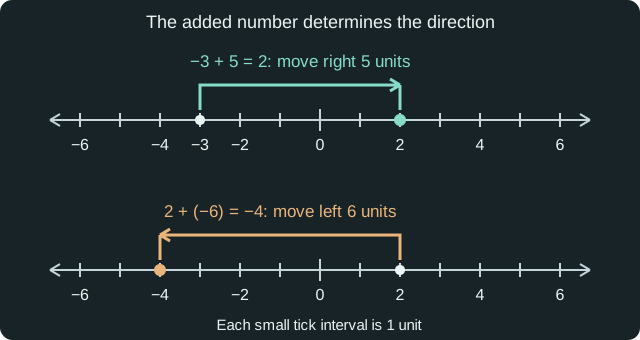
In the top drawing, \(-3+5=2\): three units reach zero and two more reach 2. In the lower drawing, \(2+(-6)=-4\): two units left reach zero, then four more reach −4. The direction does not depend on whether the starting position is positive or negative.
Worked example
Problem: Find \(-4+(-3)\).
Start at −4 and move three units left because the second addend is negative. The successive positions are −5, −6, and −7. Therefore, \(-4+(-3)=-7\).
Both changes point in the negative direction. Their magnitudes add: \(4+3=7\), and their common negative sign is retained. As a check, adding a negative amount must put the result to the left of −4; −7 does, while +7 would not.
Zero pairs explain cancellation
A zero pair consists of +1 and −1, whose sum is zero. Adding or removing such a pair changes the representation but not the total. Signed counters are one way to visualise this idea; the symbols on the counters, not their colours, determine their values.
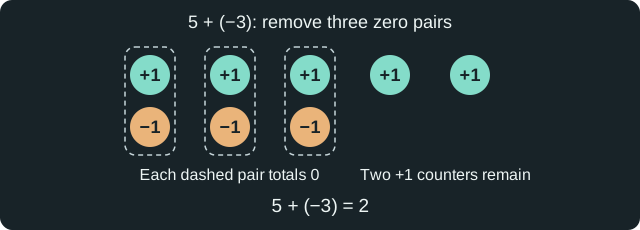
Figure 2 models \(5+(-3)=2\). If there were three positive counters and five negative counters instead, three zero pairs would leave two negative counters, giving −2. This explains why the larger magnitude determines the sign when the addends have different signs.
A decision table for integer addition
| Situation | Magnitude calculation | Sign of the sum | Example |
|---|---|---|---|
| Both positive | Add magnitudes | Positive | \(6+8=14\) |
| Both negative | Add magnitudes | Negative | \(-6+(-8)=-14\) |
| Different signs, unequal magnitudes | Larger magnitude minus smaller | Sign of the larger-magnitude addend | \(-8+6=-2\) |
| Opposite values | Equal magnitudes cancel | Zero; neither positive nor negative | \(-8+8=0\) |
| One addend is zero | Keep the other addend | Keep its sign, if nonzero | \(-8+0=-8\) |
Compare absolute values when applying the different-sign rule. In \(-18+7\), the larger signed number is 7, but the larger magnitude is 18. The negative magnitude dominates, so the sum is negative.
Worked example: different signs and a positive result
Problem: An account balance is −9 dollars and a deposit adds 14 dollars. Find the new balance, assuming no fees or other transactions.
The signed calculation is \(-9+14\). Pair nine positive dollars with the nine negative dollars; five positive dollars remain. Equivalently, the magnitudes give \(14-9=5\), with the sign of +14.
The new balance is +5 dollars. On a number line, move 14 units right from −9: nine reach zero, and five more reach +5. Adding a deposit can cross zero; it does not merely remove the minus sign from the original balance.
Worked example: different signs and a negative result
Problem: Find \(7+(-18)\).
The magnitudes are 7 and 18. Seven positive units cancel seven of the eighteen negative units, leaving eleven negative units. Therefore,
\[7+(-18)=-(18-7)=-11.\]
Check the direction: starting at +7, a move of 18 units left must pass zero and end at −11. The magnitude is 11, not 25: different directions partially cancel rather than reinforce one another.
Worked example: opposite addends and zero
Problem: Evaluate \(-23+23\), \(0+(-23)\), and \(-23+0\).
The first sum is 0, because the twenty-three negative units cancel the twenty-three positive units. The other two sums are both −23, because adding zero makes no change.
For any integer \(a\), these ideas are written \(a+(-a)=0\) and \(a+0=0+a=a\). The opposite \(-a\) is also called the additive inverse of \(a\).
Addition properties still work for integers
For integers \(a\), \(b\), and \(c\):
- Commutative property: \(a+b=b+a\). You can change addend order if each number keeps its sign.
- Associative property: \((a+b)+c=a+(b+c)\). You can regroup additions without changing the sum.
- Identity property: adding zero leaves the other addend unchanged.
These properties let you pair opposites or combine convenient terms. They do not let you discard negative signs or apply addition rules directly to an arbitrary subtraction expression.
Worked example: three addends and two checking methods
Problem: Evaluate \(-12+7+(-5)\).
From left to right, \(-12+7=-5\), then \(-5+(-5)=-10\). Alternatively, combine the negative addends first: \(-12+(-5)=-17\), then \(-17+7=-10\).
Both methods give −10, providing a check using the associative and commutative properties. Regrouping preserves each signed addend: the −5 must not become +5 just because it moves to a different position in the written sum.
Worked example: temperature and sequential changes
Problem: The temperature starts at −3°C, rises by 8°C, then falls by 6°C. What is the final temperature?
A rise is a positive change and a fall is a negative change. Write the starting value plus both signed changes:
\[-3+8+(-6)=5+(-6)=-1.\]
The final temperature is −1°C. A second check combines the changes first: \(8+(-6)=2\), a net rise of 2°C; starting at −3°C and rising 2°C also gives −1°C.
The final temperature, −1°C, differs from the net change, +2°C. Always identify which quantity the question asks for.
Worked example: find a missing addend
Problem: Find the integer that makes \(-6+\square=4\) true.
Starting at −6, it takes six units right to reach zero and another four right to reach 4. The missing addend is therefore +10. Substitute to check: \(-6+10=4\).
This problem asks for a signed change, not the final position. An opposite value, +6, would reach zero but would not complete the move to 4.
Check your understanding
Try these before reading the explanations. These lesson self-checks do not alter the separate Quizzes and Practice tabs.
- Find \(-8+(-6)\). Describe the direction of movement.
- Find \(-15+9\), using absolute values to determine the sign.
- Find \(17+(-9)\).
- Find \(-24+24\) and \(-24+0\).
- Evaluate \(-7+12+(-8)\) in two different groupings.
- Start at −5 on a number line and add +8. Where do you finish? How many units do you move?
- The temperature is 4°C and changes by −11°C. What is the final temperature?
- Find the missing addend in \(-9+\square=-2\).
- A student claims \(-12+5=7\) because 12 − 5 = 7. What is missing from the reasoning?
- A player starts with −16 points, gains 11 points, and then receives a change of −4 points. Find the final score and the net change.
Solutions and reasoning
- −14. From −8, move six units left. Same negative signs reinforce: add 8 and 6 and keep the negative sign.
- −6. \(|-15|=15\) exceeds \(|9|=9\); subtract magnitudes, \(15-9=6\), and keep the negative sign.
- 8. The positive magnitude 17 exceeds 9, leaving eight positive units.
- 0 and −24, respectively. Opposites cancel; zero makes no change.
- −3. Left to right gives \(5+(-8)=-3\). Grouping the negatives first gives \(-15+12=-3\).
- Finish at 3, after moving eight units right. Three is the endpoint, not the length of the move.
- −7°C, because \(4+(-11)=-7\). The change is −11°C, distinct from the final temperature.
- 7. From −9 to −2 is seven units right; check \(-9+7=-2\).
- The magnitude 7 is correct, but the sign was lost. The negative addend has the larger magnitude, so the sum is −7.
- Final score −9 points: \(-16+11+(-4)=-9\). Net change +7 points: \(11+(-4)=7\).
Common mistakes
- Applying a multiplication sign rule to addition: Two negative addends produce a negative sum, not a positive one.
- Comparing signed values instead of magnitudes: To choose the resulting sign in a different-sign sum, compare absolute values.
- Always adding the magnitudes: Opposite directions cancel in part or completely.
- Always subtracting the magnitudes: Same-sign addends reinforce and require addition of magnitudes.
- Choosing direction from the starting number: The added number determines the move.
- Counting endpoint ticks instead of intervals: A five-unit move crosses five unit intervals.
- Dropping a sign when regrouping: Keep each addend and its sign together.
- Confusing a final value with a net change: Add the net change to the initial value to get the final value.
Key takeaway
Integer addition combines signed amounts or changes. Positive addends move right and negative addends move left. Same signs add magnitudes; different signs cancel magnitudes, leaving the sign of the larger magnitude unless they cancel to zero. Use a number line or zero pairs to explain the rules, and preserve every sign when regrouping.
Continue learning
- The Number Line and Absolute Value: distinguish position, direction, and magnitude.
- Integer Subtraction: connect subtraction with adding an opposite.
- Integer Products: distinguish multiplication sign rules from addition rules.
- Variables and Expressions: evaluate expressions with signed inputs.
Sources and further reading
Public textbook materials were consulted for topic coverage and teaching models. The explanations, numerical examples, table, self-checks, and SVG diagrams here were independently created. No textbook prose, exercises, or artwork are reproduced or closely paraphrased.
- OpenStax Prealgebra 2e: Add Integers — integer-addition topic coverage.
- OpenStax Prealgebra 2e: preface and reuse conditions — consult current restrictions before reproducing textbook material.
- Siyavula: Calculations with Integers — related number-line calculation coverage.
- Siyavula: Integers and textbook license notice — textbook content attribution terms; external media may have different terms.