Prealgebra · Unit 5 · Topic 5.3
Percents, Fractions, and Decimals
Convert percents, fractions, and decimals using per-hundred reasoning; interpret small and large percentages, compare forms, and distinguish exact values from rounded answers.
What does percent mean?
Percent means “per hundred.” A percentage \(p\%\) represents the number \(\frac p{100}\). Fractions, decimals, and percents can name the same value: \(35\%=\frac{35}{100}=\frac7{20}=0.35\).
In a situation involving an amount, identify the base or reference whole. For example, 35% of a collection means 35 hundredths of that collection, not necessarily 35 objects.
This lesson focuses on converting between the three forms, interpreting their sizes, and comparing values. The next lessons develop percent applications and percent change more fully.
One whole is 100 percent
The same proportion can be expressed in different forms:
| Fraction | Decimal | Percent | Meaning relative to a whole |
|---|---|---|---|
| \(0\) | \(0\) | \(0\%\) | None of the whole |
| \(\frac1{100}\) | \(0.01\) | \(1\%\) | One hundredth |
| \(\frac1{10}\) | \(0.1\) | \(10\%\) | One tenth |
| \(\frac14\) | \(0.25\) | \(25\%\) | One quarter |
| \(\frac12\) | \(0.5\) | \(50\%\) | One half |
| \(\frac34\) | \(0.75\) | \(75\%\) | Three quarters |
| \(1\) | \(1.0\) | \(100\%\) | One whole |
The percent sign contributes the division by 100. Thus \(35\%=0.35\), but the ordinary number \(35\) is not equal to 0.35.
See the same value in three forms
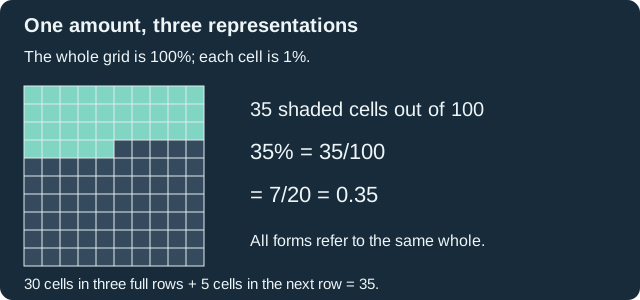
The grid is a model of a proportion. It does not require a real collection to contain exactly 100 items. A fraction of a larger or smaller reference amount can still be 35%.
Conversion routes and why they work
| Starting form | Requested form | Method |
|---|---|---|
| Percent \(p\%\) | Decimal | Divide the percent number \(p\) by 100; remove the percent sign |
| Percent \(p\%\) | Fraction | Write \(p/100\), clear any decimal numerator, then simplify |
| Decimal \(d\) | Percent | Multiply the decimal's numerical value by 100 and attach % |
| Fraction \(a/b\) | Decimal | Divide \(a\) by nonzero \(b\) |
| Fraction \(a/b\) | Percent | Compute \(100(a/b)\), then attach % |
| Terminating decimal | Fraction | Use a power-of-ten denominator, then simplify |
Writing \(d=(100d)\%\) preserves value because \((100d)\%=\frac{100d}{100}=d\). Simply appending a percent sign without changing the written number does not preserve value.
“Move the decimal two places” is shorthand for multiplying or dividing by 100. Decide which direction from the operation, and include placeholder zeros if needed.
Worked example
Problem: Convert 35% to a decimal and a simplest fraction, then find 35% of 80 counters.
First use the per-hundred definition:
\[35\%=\frac{35}{100}=0.35=\frac7{20}.\]
To simplify the fraction, divide both entries by their GCF, 5. To find the amount, multiply the decimal or fraction by the base:
\[0.35\times80=28,\qquad \frac7{20}\times80=28.\]
The answer is 28 counters, not 35 counters. Here 80 counters is the reference whole. Check by dividing back: \(\frac{28}{80}=\frac7{20}=35\%\).
Worked example: percent to decimal, including small percents
Problem: Convert 8% and 0.6% to decimals.
\[8\%=\frac8{100}=0.08,\qquad0.6\%=\frac{0.6}{100}=0.006.\]
Eight percent is below one tenth. A percentage below 1% has a decimal value below 0.01. Do not mistake 0.6% for 0.6: the latter equals 60%.
To express 0.6% as a simplest fraction, clear the decimal numerator:
\[\frac{0.6}{100}=\frac6{1000}=\frac3{500}.\]
Worked example: decimal to percent
Problem: Convert 0.42, 0.007, and 1.4 to percents.
Multiply each numerical value by 100 and attach the percent sign:
\[0.42=42\%,\qquad0.007=0.7\%,\qquad1.4=140\%.\]
Check the reverse route: \(42\div100=0.42\), \(0.7\div100=0.007\), and \(140\div100=1.4\).
Do not write \(0.42=0.42\%\); 0.42% equals 0.0042, which is 100 times smaller.
Worked example: a decimal percent to a fraction
Problem: Convert 17.5% to a fraction in simplest form.
\[17.5\%=\frac{17.5}{100}=\frac{175}{1000}=\frac7{40}.\]
Multiply both entries by 10 to remove the decimal from the numerator, then divide by 25. The equivalent decimal is 0.175.
The denominator 100 in the initial expression comes from the percent sign, not from the decimal places of 17.5. Forgetting the percent sign would convert 17.5 itself instead.
Worked example: fraction to percent
Problem: Convert \(\frac7{8}\) to a percent.
Divide to get the exact decimal: \(7\div8=0.875\). Then
\[\frac78=0.875=87.5\%.\]
As a check, \(87.5\div100=0.875\). Percentages need not be whole numbers. Trying to obtain denominator 100 with an integer multiplier is not always convenient; decimal division is a valid alternative.
Worked example: repeating fractions and exact percentages
Problem: Convert \(\frac16\) to a percent, exactly and to the nearest hundredth of a percent.
Multiply by 100 to obtain the percent number:
\[100\times\frac16=\frac{50}{3}=16\frac23.\]
Therefore \(\frac16=16\frac23\%=16.\overline6\%\) exactly. Rounded to the nearest hundredth of a percent,
\[\frac16\approx16.67\%.\]
The exact decimal value of the original fraction is \(0.1\overline6\), not 16.67. Preserve the distinction between the decimal value and the number written before %.
Keep the exact fraction or additional decimal digits until the last step. Truncating \(\frac16\) to 0.16 before converting would give 16%, a less accurate approximation.
Percentages greater than 100
A percentage above 100% represents more than one reference whole. For example,
\[140\%=\frac{140}{100}=\frac75=1.4.\]
If a target is 50 pages and a reader completes 70 pages, completion relative to that target is \(\frac{70}{50}=1.4=140\%\). This is a constructed example, not a reported statistic.
However, a subgroup counted without overlap inside a fixed collection cannot contain more members than that collection; its part-to-whole percentage is between 0% and 100%. A value above 100% would require a different interpretation or signal an error in that context.
Also distinguish “140% of the original” from “140% more than the original.” The first is \(1.4\) times the original; the second adds \(1.4\) originals to the original, giving \(2.4\) times it.
Worked example: compare mixed representations
Problem: Order \(0.38,\ 40\%,\ \frac38\) from least to greatest.
Convert to exact decimals: \(40\%=0.400\) and \(\frac38=0.375\). Write \(0.38=0.380\), then compare:
\[\frac38<0.38<40\%.\]
Use one representation consistently. Comparing the bare numbers 38, 40, and 3 ignores their scales and denominators.
A percent needs a base in an application
Twenty-five percent of 40 is 10, while 25% of 100 is 25. The percentage is the same; the amounts differ because the reference wholes differ.
If 3 red counters and 2 blue counters make the entire collection, the red-to-blue ratio is \(3:2\), but the red fraction of the collection is \(\frac3{3+2}=\frac35=60\%\). Do not treat the part-to-part ratio \(\frac32=150\%\) as the percentage of all counters that are red.
Percent is a dimensionless ratio. When multiplying it by a base amount, the resulting quantity takes the base's units.
Percent points and relative change are different
As a bridge to the Percent Change lesson, a rate rising from 30% to 45% increases by 15 percentage points. Relative to the old rate, the increase is \(\frac{45-30}{30}=\frac12=50\%\).
Subtraction finds the percentage-point difference; division by the old value finds relative change. State which comparison is intended.
Common mistakes
- Ignoring the percent sign: \(8\%=0.08\), not 8.
- Using the wrong conversion direction: Percent to decimal divides by 100; decimal to percent multiplies the written number by 100.
- Appending % without scaling: \(0.7=70\%\), not 0.7%.
- Assuming percents must be integers or below 100: Small decimal percentages and percentages above 100 can be valid.
- Dropping the reference whole: Equal percentages of different bases need not give equal amounts.
- Confusing part-to-part with part-to-whole: Count the entire base before forming a percentage of it.
- Rounding a repeating value too early: Use exact notation or mark a rounded percentage with \(\approx\).
- Mixing percentage points with percent change: A difference and a relative change answer different questions.
Check your understanding
Try these before reading the explanations. These self-checks do not modify the separate Quizzes or Practice tabs.
- Convert 64% to a decimal and a simplest fraction.
- Convert 0.09 to a percent.
- Convert 0.004 to a percent.
- Convert 2.25 to a percent.
- Convert 7.5% to a decimal and a simplest fraction.
- Convert \(\frac{13}{20}\) to a decimal and a percent.
- Convert \(\frac23\) to an exact percent and round to the nearest hundredth of a percent.
- Convert 0.08% to a decimal.
- Order \(\frac25,\ 0.39,\ 41\%\) from least to greatest.
- Find 35% of 60. Identify the base.
- A group has 6 adults and 9 children. What percentage of the whole group are adults?
- A completion rate changes from 20% to 35%. Find the percentage-point increase and the relative percent increase.
Answers and explanations
- \(64\%=0.64=\frac{64}{100}=\frac{16}{25}\).
- \(0.09=9\%\), multiplying the decimal number by 100.
- \(0.004=0.4\%\). This is below 1%.
- \(2.25=225\%\), more than two reference wholes.
- \(7.5\%=0.075=\frac{75}{1000}=\frac3{40}\).
- \(\frac{13}{20}=0.65=65\%\).
- \(\frac23=66\frac23\%=66.\overline6\%\), approximately 66.67%.
- \(0.08\%=0.0008\), dividing 0.08 by 100.
- \(0.39<\frac25<41\%\), since \(0.39<0.40<0.41\).
- \(0.35\times60=21\). The base is 60.
- The base is all 15 people: \(\frac6{15}=\frac25=40\%\), not \(\frac69\).
- 15 percentage points, and \(\frac{35-20}{20}\times100\%=75\%\) relative increase.
Key takeaway
Percent expresses a value per hundred: \(p\%=p/100\). Divide by 100 to obtain a decimal; multiply a decimal's numerical value by 100 and attach % to express the same value as a percent. Fractions follow the same reasoning. Identify the reference whole in applications, preserve exact values when possible, and label approximations and comparison types clearly.
Related lessons
- Converting Fractions and Decimals: exact and repeating forms
- Decimal Place Value and Comparing Decimals: interpret small values
- Ratios and Unit Rates: part-to-part versus part-to-whole
- Equivalent Ratios and Proportions: comparisons per hundred
- Percent Applications: calculate unknown amounts and bases
- Percent Change: distinguish relative changes from percentage points
Sources and authorship
The public educational resources below were consulted for topic coverage and mathematical checks. This lesson's explanations, example settings, self-checks, table, and diagram were independently created; source prose, exercise sets, and artwork are not reproduced. Public access does not imply unrestricted reuse: consult each source's current license before reproducing material.