Prealgebra · Unit 10 · Topic 10.1
Ordered Pairs and the Coordinate Plane
Locate and read ordered pairs on a coordinate plane, identify quadrants and axis points, and calculate horizontal distance from coordinates.
Two numbers give one location
“Three units from the center” does not locate a point: it could be left, right, above, or below. A coordinate plane supplies two directed number lines so that a location can be stated without guessing. The horizontal number line is the \(x\)-axis; positive \(x\) goes right and negative \(x\) goes left. The vertical number line is the \(y\)-axis; positive \(y\) goes up and negative \(y\) goes down. Their intersection is the origin, \((0,0)\).
An ordered pair \((x,y)\) records the horizontal coordinate first and the vertical coordinate second. Both coordinates are signed numbers, and zero is allowed. In the grid below, each numbered step on either axis represents one grid unit. A point need not have whole-number coordinates—\((1.5,-2)\), for example, is also a possible location.
Plot a point, then read it back
For \(A=(-3,4)\), start at \((0,0)\). The first coordinate, \(-3\), sends you three units left. From there the second coordinate, \(4\), sends you four units up. Mark the endpoint. The light guide in the graph follows these two moves. To read the point back, trace it vertically to \(x=-3\) and horizontally to \(y=4\); those two grid lines meet only at \(A\).
Now compare \(B=(4,-3)\). It is four units right and three down. The same two numbers appear in \(A\) and \(B\), but swapping their positions changes both directions:
\[ (-3,4)\ne(4,-3). \]
That is why the word ordered matters. A list of two numbers without a fixed order would not identify a unique point.
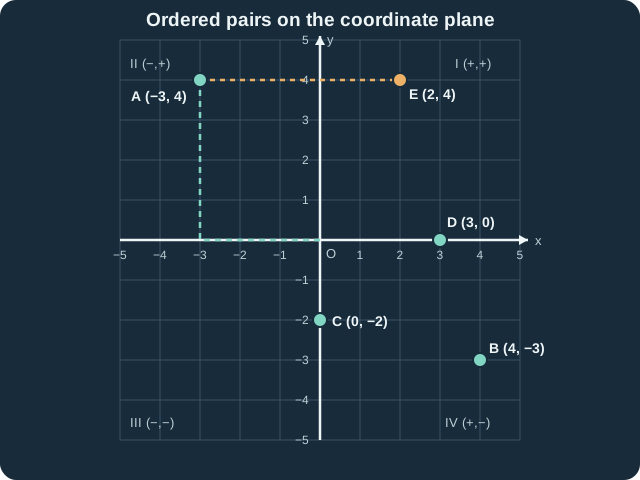
The four open regions between the axes are called quadrants. They are numbered counterclockwise starting in the upper-right region. You can locate a quadrant from the signs alone:
| Quadrant | \(x\) sign | \(y\) sign | Example |
|---|---|---|---|
| I | \(+\) | \(+\) | \(E=(2,4)\) |
| II | \(-\) | \(+\) | \(A=(-3,4)\) |
| III | \(-\) | \(-\) | \((-2,-1)\) |
| IV | \(+\) | \(-\) | \(B=(4,-3)\) |
The sign table works only when neither coordinate is zero. \(C=(0,-2)\) has \(x=0\), so it lies on the \(y\)-axis. \(D=(3,0)\) has \(y=0\), so it lies on the \(x\)-axis. Neither is in a quadrant, and the origin lies on both axes. In symbols,
\[ x=0\ \Longrightarrow\ \text{a point on the }y\text{-axis}, \qquad y=0\ \Longrightarrow\ \text{a point on the }x\text{-axis}. \]
These are tests for a point's position, not instructions to swap the axis names: the \(x\)-coordinate is zero along the \(y\)-axis because there is no horizontal movement from the origin.
Coordinates also let us compare positions
\(A=(-3,4)\) and \(E=(2,4)\) have the same \(y\)-coordinate, so they lie on one horizontal line. Moving from \(x=-3\) to \(x=0\) takes three units; moving from \(0\) to \(x=2\) takes two more. The horizontal distance is five grid units:
\[ \text{horizontal distance} =|x_E-x_A| =|2-(-3)| =|5| =5\text{ grid units}. \]
The absolute-value bars make a distance nonnegative regardless of which point is named first: \(|-3-2|=5\) as well. This formula gives the full distance between the two points only because their \(y\)-coordinates are equal. If their heights differ, it gives just the horizontal part of the separation.
When reading any coordinate graph, check the axis labels and scale before using a formula. Here both axes count grid units; on a real graph \(x\) might represent hours and \(y\) might represent dollars, so the two coordinates would not be interchangeable and their differences would carry different units.
As a quick check, consider \(F=(-4,0)\). Its negative first coordinate places it four units left of the origin, and its zero second coordinate keeps it on the \(x\)-axis—not in Quadrant II or III. The axis test settles a case that a sign-only quadrant rule cannot.
Further reading
The coordinate-system definitions, quadrant sign convention, and axis cases were checked against OpenStax Prealgebra 2e §11.1. The prose, point set, distance example, table, and SVG grid here were independently created; no textbook text, exercises, or artwork were reproduced.