Prealgebra · Unit 4 · Topic 4.3
Converting Fractions and Decimals
Convert fractions and decimals using division and place value, distinguish terminating and repeating forms, simplify results, and compare exact values with worked examples.
How do you convert between fractions and decimals?
To convert a fraction to a decimal, divide its numerator by its nonzero denominator. To convert a terminating decimal to a fraction, use its place value to write it over a power of ten, then simplify. Conversion changes the representation, not the numerical value.
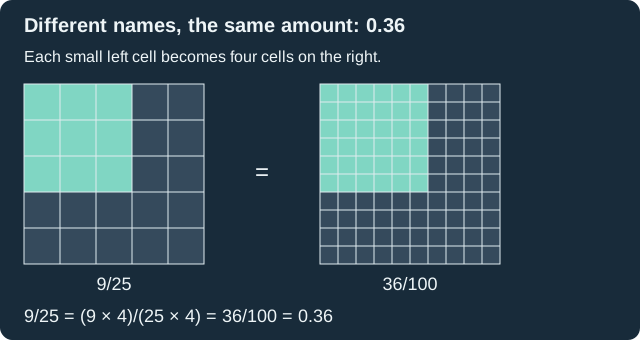
For example, \(\frac9{25}=\frac{36}{100}=0.36\). Nine twenty-fifths and thirty-six hundredths name the same amount. Some fractions produce a decimal that terminates; others produce an endlessly repeating decimal.
This lesson explains both directions, long division, repeating notation, comparisons, and the distinction between exact values and rounded approximations.
Decimal to fraction: count place-value units
A terminating decimal has finitely many written decimal digits. If a nonnegative decimal has \(n\) places after the point, it can be written as
\[x=\frac{N}{10^n}.\]
Here \(N\) is the integer obtained by reading the digits without the decimal point, and \(n\) is the number of decimal places. For example, \(0.047=\frac{47}{1000}\), because the last digit is in the thousandths place.
- Identify the last decimal place.
- Write the number over 10, 100, 1000, or another appropriate power of ten.
- Simplify numerator and denominator by their greatest common factor.
- Preserve the sign and check by dividing back.
Do not choose the denominator from the number of nonzero digits. Placeholder zeros count as decimal positions too.
Worked example
Problem: Convert \(0.36\) to a fraction in simplest form.
The final digit is in the hundredths place, so \(0.36=\frac{36}{100}\). The greatest common factor of 36 and 100 is 4:
\[0.36=\frac{36}{100}=\frac{36\div4}{100\div4}=\frac9{25}.\]
The remaining entries share no factor greater than 1. Check by multiplying both entries by 4 to recover \(\frac{36}{100}\).
Worked example: small decimals and trailing zeros
Problem: Convert \(0.075\) and \(0.750\) to simplest fractions.
Both written decimals have three places:
\[0.075=\frac{75}{1000}=\frac3{40},\qquad 0.750=\frac{750}{1000}=\frac34.\]
For the first, divide both entries by 25; for the second, divide by 250. The zero after the point in \(0.075\) puts the 7 in the hundredths place. Removing that zero would change the value.
The last zero of \(0.750\) is trailing, so you could instead begin with \(0.75=\frac{75}{100}=\frac34\). Different unsimplified fractions can represent the same value.
Worked example: values above one and negative values
Problem: Convert \(2.48\) and \(-0.125\).
\[2.48=\frac{248}{100}=\frac{62}{25}=2\frac{12}{25}.\]
The whole-number digits are included in 248. Alternatively, write \(2+\frac{48}{100}\) and simplify the fractional part.
\[-0.125=-\frac{125}{1000}=-\frac18.\]
The negative sign applies to the entire value. A fraction can be improper or negative; conversion is not restricted to positive values below 1.
Fraction to decimal: make a power-of-ten denominator
If you can multiply an integer fraction's numerator and denominator by the same positive integer to obtain a denominator of 10, 100, 1000, or another power of ten, its decimal form follows directly.
Problem: Convert \(\frac{13}{20}\).
Since \(20\times5=100\),
\[\frac{13}{20}=\frac{13\times5}{20\times5}=\frac{65}{100}=0.65.\]
The numerator must also be multiplied by 5; writing \(\frac{13}{100}\) would change the value. If this method is inconvenient, division always works.
Worked example: long division produces a terminating decimal
Problem: Convert \(\frac78\).
The fraction bar means \(7\div8\). Because 7 is less than 8, the quotient begins with \(0.\). Use \(7.000\) to continue dividing:
| Step | Divide | Next quotient digit | Remainder |
|---|---|---|---|
| Tenths | \(70\div8\) | 8 | \(70-64=6\) |
| Hundredths | \(60\div8\) | 7 | \(60-56=4\) |
| Thousandths | \(40\div8\) | 5 | \(40-40=0\) |
The successive digits are 8, 7, and 5, so \(\frac78=0.875\). The zero remainder means no further nonzero digits are needed. Check: \(0.875\times8=7\).
In each new decimal step, express the remainder in the next smaller unit by multiplying its count by 10. The zeros appended to 7 do not change its value.
Repeating decimals: a remainder returns
Problem: Convert \(\frac5{12}\).
The quotient begins with 0. At the tenths step, \(50\div12\) gives digit 4 and remainder 2. At the hundredths step, \(20\div12\) gives digit 1 and remainder 8. Then \(80\div12\) gives digit 6 and remainder 8 again.
The same remainder 8 produces the same next digit 6 every time, so
\[\frac5{12}=0.41666\ldots=0.41\overline6.\]
Only the 6 repeats; the initial 4 and 1 do not. An overbar identifies the endlessly repeating block. For example, \(0.\overline{27}\) means \(0.272727\ldots\), not \(0.2777\ldots\).
For an integer fraction with positive denominator \(b\), long-division remainders are among \(0,1,\ldots,b-1\). Either remainder 0 is reached, ending the decimal, or a nonzero remainder eventually returns, forcing a repeating pattern. Thus rational numbers have terminating or eventually repeating decimal forms.
Predict whether an integer fraction terminates
First put the fraction in simplest form and use a positive denominator. Its decimal terminates exactly when that denominator's only prime factors are 2 and 5. A denominator of 1 also terminates because the value is an integer.
Why? A power of ten is \(10^n=2^n5^n\). A simplified denominator made only of 2s and 5s divides some power of ten, so the fraction can be rewritten with that power as its denominator. Conversely, if the decimal terminates, simplifying its power-of-ten fraction cannot introduce a prime other than 2 or 5.
- \(\frac7{40}\): \(40=2^3\times5\), so it terminates; multiplying both entries by 25 gives \(\frac{175}{1000}=0.175\).
- \(\frac7{15}\): the denominator includes a factor 3, so its decimal repeats.
- \(\frac9{24}=\frac38\): after simplification the denominator is \(8=2^3\), so the value terminates at \(0.375\). Checking the original denominator before simplifying would give the wrong prediction.
Optional extension: turn a repeating decimal into a fraction
A repeating decimal is exact, but it cannot be converted merely by counting a finite number of places. For a repeating block beginning immediately after the point, subtraction can remove the infinite tail.
Problem: Convert \(0.\overline{27}\).
Let \(x=0.272727\ldots\). The repeating block has two digits, so multiply by 100:
\[100x=27.272727\ldots.\]
Subtract the original \(x\); the identical decimal tails cancel:
\[99x=27,\qquad x=\frac{27}{99}=\frac3{11}.\]
This exact argument is different from treating a truncated display \(0.27\) as the entire decimal. In fact, \(0.27=\frac{27}{100}\), not \(\frac3{11}\). Repeating decimals with initial nonrepeating digits require aligning their tails before subtraction.
Exact equality versus approximation
The repeating decimal \(0.\overline3\) is exactly \(\frac13\). The terminating decimal \(0.333\) is exactly \(\frac{333}{1000}\), a slightly smaller value:
\[\frac13-\frac{333}{1000}=\frac1{3000}.\]
To the nearest hundredth, \(\frac13\approx0.33\). Use \(=\) for exact equality and \(\approx\) for a rounded or truncated approximation. A calculator's finite display does not by itself show that the true decimal terminates.
For \(\frac5{12}=0.41666\ldots\), rounding to the nearest hundredth gives \(\frac5{12}\approx0.42\), because the third decimal digit is 6. Retain extra digits until the final rounding step.
Worked example: compare values in different forms
Problem: Order \(\frac35,\ 0.58,\ \frac58\) from least to greatest.
Convert exactly: \(\frac35=0.600\) and \(\frac58=0.625\). Write \(0.58=0.580\), then compare aligned places:
\[0.58<\frac35<\frac58.\]
If conversion would require an approximation, an exact fraction comparison can be safer. For example, \(\frac23\) exceeds \(0.66=\frac{66}{100}\), because \(2\times100=200>3\times66=198\). Truncating \(\frac23\) to 0.66 before comparing would conceal this difference; rounding it to the nearest hundredth would instead give 0.67.
Worked example: combine fractions and decimals
Problem: A bottle contains \(\frac35\) litre, and 0.25 litre is added. Find the total.
Convert to a shared representation. Using decimals:
\[0.6+0.25=0.85\text{ litre}.\]
Using fractions:
\[\frac35+\frac14=\frac{12}{20}+\frac5{20}=\frac{17}{20}\text{ litre}.\]
Both answers are exact: \(\frac{17}{20}=0.85\). All amounts refer to litres. Choose the form that makes the calculation clear, rather than converting repeatedly or rounding unnecessarily.
Common mistakes
- Dividing in the wrong order: \(\frac38\) means \(3\div8\), not \(8\div3\).
- Choosing the wrong power of ten: \(0.045=\frac{45}{1000}\), not \(\frac{45}{100}\).
- Changing only the denominator: Equivalent fractions require the same multiplier or divisor for both entries.
- Forgetting to simplify: \(\frac{36}{100}\) is correct but not simplest; its simplest form is \(\frac9{25}\).
- Testing termination before simplifying: A canceled factor of 3 in a denominator does not force the final value to repeat.
- Putting the overbar over the wrong digits: \(0.41\overline6\) repeats only 6, not 416.
- Equating a finite display with an infinite decimal: \(0.333\ne\frac13\). State when an answer is approximate.
Check your understanding
Try these before reading the explanations. These self-checks do not change the separate Quizzes or Practice tabs.
- Convert \(0.48\) to a simplest fraction.
- Convert \(0.006\) to a simplest fraction.
- Convert \(1.35\) to an improper fraction and a mixed number.
- Convert \(-0.375\) to a simplest fraction.
- Convert \(\frac{17}{25}\) to a decimal using a power-of-ten denominator.
- Convert \(\frac{11}{8}\) to a decimal.
- Does \(\frac{14}{60}\) terminate? Simplify before explaining.
- Convert \(\frac23\) to repeating notation and round to the nearest hundredth.
- Is \(0.444\) exactly \(\frac49\)? Explain.
- Order \(0.7,\ \frac34,\ \frac{17}{25}\) from least to greatest.
- Compute \(\frac78+0.125\) exactly.
- Use the extension method to convert \(0.\overline{18}\) to a simplest fraction.
Answers and explanations
- \(\frac{48}{100}=\frac{12}{25}\), dividing both entries by 4.
- \(\frac6{1000}=\frac3{500}\), dividing by 2. Three decimal places require thousandths.
- \(\frac{135}{100}=\frac{27}{20}=1\frac7{20}\).
- \(-\frac{375}{1000}=-\frac38\), dividing by 125.
- \(\frac{17}{25}=\frac{68}{100}=0.68\).
- \(11\div8=1.375\). Check: \(1.375\times8=11\).
- \(\frac{14}{60}=\frac7{30}\). Since \(30=2\times3\times5\) contains factor 3, its decimal repeats.
- \(\frac23=0.\overline6\), and \(\frac23\approx0.67\) to the nearest hundredth.
- No. \(\frac49=0.\overline4\), whereas \(0.444=\frac{444}{1000}=\frac{111}{250}\) stops after three places.
- \(\frac{17}{25}<0.7<\frac34\), because \(0.68<0.70<0.75\).
- \(0.875+0.125=1\). Equivalently, \(\frac78+\frac18=1\).
- If \(x=0.\overline{18}\), then \(100x-x=18\), so \(x=\frac{18}{99}=\frac2{11}\).
Key takeaway
Fractions and decimals can name the same value. Use place value and simplification to convert terminating decimals into fractions; use an equivalent power-of-ten denominator or division to convert fractions into decimals. A zero remainder ends long division; a returning nonzero remainder creates repetition. Mark the repeating block precisely and distinguish exact equality from approximation.
Related lessons
- Decimal Place Value and Comparing Decimals: choose the correct power-of-ten denominator
- Calculating with Decimals: division and rounding
- Fractions and Equivalent Forms: preserve value while changing representation
- Greatest Common Factor and Least Common Multiple: simplify fractions
- Mixed Numbers and Fraction Applications: values above one
Sources and authorship
The public textbook resources below were consulted for topic coverage and mathematical checks. The explanations, example settings, self-checks, and diagram here were independently created; textbook prose, exercise sets, and artwork are not reproduced. Public access does not mean unrestricted reuse: consult each source's current license before reproducing its material.
- OpenStax Prealgebra 2e, 5.3: Decimals and Fractions
- OpenStax Prealgebra 2e, 5.1: Decimals and place-value conversion
- OpenStax Prealgebra 2e: preface and reuse conditions
- Siyavula Mathematical Literacy: Operations using numbers and calculator skills, including fraction–decimal conversion
- Siyavula: open-textbook access and licensing