Prealgebra · Unit 6 · Topic 6.4
The Distributive Property
Expand and factor expressions using the distributive property; apply signed, fractional, and decimal factors, combine like terms, and explain the rule with a split-rectangle area model.
What does the distributive property say?
Multiplying a sum or difference by a number is equivalent to multiplying each term by that number and then adding or subtracting the products. Every term inside the group receives the complete outside factor, including its sign.
For real numbers \(a,b,c\):
\[a(b+c)=ab+ac,\qquad a(b-c)=ab-ac.\]
For example, \(4(10+3)=4\cdot10+4\cdot3=40+12=52\). The grouped form and expanded form describe the same value. These rules apply to positive and negative numbers, fractions, decimals, and variable expressions with real-number values.
All examples, self-checks, and the diagram below were independently created for this lesson.
See the rule in a rectangle
A rectangle with height 3 units and width \(4+2\) units has area \(3(4+2)=18\) square units. Splitting the width into 4 and 2 gives two rectangles with areas 12 and 6. Their combined area remains 18.
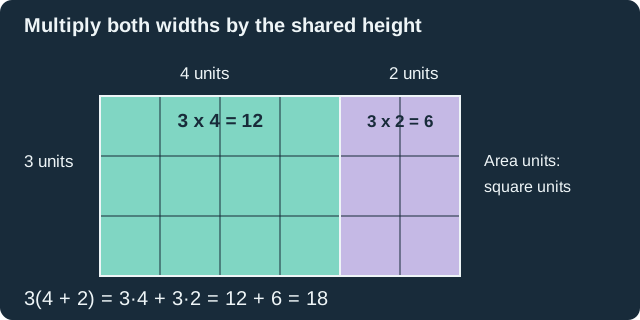
The height multiplies both widths. Writing \(3(4+2)=3\cdot4+2\) would leave the second piece without its height factor and give the wrong area.
Expanding: a reliable routine
- Identify the complete factor multiplying the group.
- Read every term inside the group with its sign. Rewrite subtraction as addition of a negative term if helpful.
- Multiply the outside factor by each term once.
- Simplify the products, then combine like terms if possible.
- Check that no term or sign was lost. A numerical substitution can help detect an error.
The rule also works with a factor on the right: \((b+c)a=ba+ca\). For three terms, \(a(b+c+d)=ab+ac+ad\). Expansion is not merely deleting parentheses.
Worked example: a positive factor
Problem: Expand \(5(2x+3)\).
\[5(2x+3)=5(2x)+5(3)=10x+15.\]
The coefficient of \(x\) becomes \(5\cdot2=10\), and the constant becomes \(5\cdot3=15\). Do not stop at \(10x+3\).
For \(x=2\), the original gives \(5(4+3)=35\) and the expanded form gives \(20+15=35\). This check supports the calculation; the distributive identity is what justifies equality for every real \(x\).
Worked example: a negative factor and subtraction
Problem: Expand \(-3(2x-5)\).
Treat the terms inside as \(2x\) and \(-5\). Then
\[-3(2x-5)=(-3)(2x)+(-3)(-5)=-6x+15.\]
The second product is positive because a negative times a negative is positive. At \(x=1\), both \(-3(2-5)\) and \(-6+15\) equal 9.
Do not write \(-6x-15\). The minus sign in \(-5\) must participate in the multiplication.
Worked example: an implied factor of negative one
Problem: Simplify \(-(x-4)\).
The minus sign before the group means multiplication by \(-1\):
\[-(x-4)=(-1)x+(-1)(-4)=-x+4.\]
Similarly, \(-(x+4)=-x-4\). Both terms change sign because both are multiplied by \(-1\).
For \(10-(2x-3)\), the 10 is outside the group being negated:
\[10-(2x-3)=10-2x+3=13-2x.\]
Do not negate the leading 10; it is not inside those parentheses.
Worked example: a fractional factor
Problem: Expand \(\frac34(8x-12)\).
\[\frac34(8x-12)=\frac34\cdot8x-\frac34\cdot12=6x-9.\]
Multiplying by a fraction still applies to every term. Here the factors of 4 in 8 and 12 make the products convenient. At \(x=2\), both forms give 3.
For a decimal example, \(0.2(15x+10)=3x+2\). Decimals and fractions follow the same property; the coefficient does not need to be a whole number.
Worked example: expand, then combine like terms
Problem: Simplify \(4(x+3)-2(x-5)\).
The complete second factor is \(-2\), not merely 2:
\[4(x+3)-2(x-5)=4x+12-2x+10.\]
Combine the variable terms and the constants:
\[(4x-2x)+(12+10)=2x+22.\]
At \(x=3\), the original is \(4(6)-2(-2)=24+4=28\); the simplified form is \(6+22=28\). Expansion uses distribution, while regrouping and combining compatible terms use other number properties.
Worked example: more than two terms
Problem: Expand \(-2(3x-y+4)\).
\[(-2)(3x)+(-2)(-y)+(-2)(4)=-6x+2y-8.\]
The implicit coefficient of \(-y\) is \(-1\). There are three terms, so there must be three distributed products before any combining. At \(x=1\), \(y=2\), both forms equal \(-10\).
Use distribution for mental arithmetic
Example: \(7\cdot98=7(100-2)=700-14=686\).
Example: \(6\cdot2.5=6(2+0.5)=12+3=15\).
Choose a convenient sum or difference without changing the number. This is exact arithmetic, not estimation.
Reverse distribution: factor out a common factor
Distribution works in both directions. Factoring rewrites a sum of products as one product containing a group:
\[ab+ac=a(b+c).\]
Problem: Factor \(12x+18\) using the greatest common positive integer factor of its coefficients.
Both terms contain a factor of 6: \(12x=6(2x)\) and \(18=6(3)\). Therefore
\[12x+18=6(2x+3).\]
Check by expanding back: \(6(2x)+6(3)=12x+18\). Extracting a factor means dividing each term by it to obtain what remains inside.
If you factor \(5x+5\), write \(5(x+1)\), not \(5x\) or \(5(x+5)\). The constant 5 becomes \(5\cdot1\), so the 1 must remain.
A quantity model with units
Suppose four identical kits each contain \(n\) pencils and three erasers. The total item count, counting pencils and erasers together, is \(4(n+3)=4n+12\). The variable \(n\) is a nonnegative whole-number pencil count per kit.
The expanded form counts all pencils and all erasers separately. For \(n=5\), there are \(4\cdot5+12=32\) items. If asked for pencils only, the answer would be \(4n\), so define which quantity you are counting before adding unlike object types.
Distinguish distribution from other rules
| Rewrite | Justification |
|---|---|
| \(3(x+2)=3x+6\) | Distributive property: multiply each part of a sum |
| \(3(2x)=(3\cdot2)x=6x\) | Associative property of multiplication: regroup a product |
| \(3x=x\cdot3\) | Commutative property of multiplication: switch factor order |
Do not distribute into a product as if it were a sum: \(3(xy)=3xy\), not \((3x)(3y)=9xy\). The factor 3 is used once in the product.
Likewise, \((x+2)^2\) is not \(x^2+4\). Squaring means multiplying the whole sum by itself, not independently squaring its terms. At \(x=1\), the values would be 9 and 5, which disproves that proposed rule.
Division: where a related rewrite works and where it fails
For a nonzero real number \(d\), dividing an entire sum by \(d\) is multiplication by \(1/d\), so
\[\frac{b+c}{d}=\frac bd+\frac cd.\]
For example, \((12+8)/4=12/4+8/4=5\). But you cannot split a sum in the denominator in the same way: \(12/(2+4)=2\), while \(12/2+12/4=9\). Always identify which quantity the outside operation acts on.
Common mistakes
- Multiplying only the first term: Every term receives the outside factor.
- Dropping a signed factor: In \(-3(2x-5)\), distribute \(-3\), not 3.
- Missing the implicit negative one: \(-(x-4)=-x+4\).
- Negating terms outside the parentheses: Preserve the outer structure.
- Combining unlike terms: \(6x-9\) cannot be merged into one term without knowing x.
- Using a sum rule on a product or power: \(3(xy)\) and \((x+2)^2\) need different treatment.
- Factoring out a number without dividing every term: Expand back to check your factorization.
- Splitting a sum in a denominator: Distribution does not authorize that rewrite.
Check your understanding
These independently written self-checks do not change the separate Quizzes or Practice tabs.
- Expand \(6(x+4)\).
- Expand \(5(3x-2)\).
- Expand \(-4(x-6)\).
- Simplify \(-(2x+7)\).
- Expand \(\frac12(10x-8)\).
- Expand \(0.25(12x+20)\).
- Simplify \(3(x+2)+2(x-5)\).
- Expand \(-3(2a-b+1)\).
- Factor \(15x+20\) using the greatest common positive integer factor of its coefficients.
- Calculate \(8\cdot99\) using distribution.
- Explain why \(2(xy)\) cannot be rewritten as \((2x)(2y)\).
- Three identical packs each contain \(n\) cards and two stickers. Write the total item-count expression in grouped and expanded forms, then evaluate it for \(n=7\).
Answers and explanations
- \(6x+24\): multiply both terms by 6.
- \(15x-10\): multiply the coefficient 3 and the signed constant \(-2\) by 5.
- \(-4x+24\): the product of \(-4\) and \(-6\) is positive.
- \(-2x-7\): multiply both terms by \(-1\).
- \(5x-4\).
- \(3x+5\).
- \(3x+6+2x-10=5x-4\).
- \(-6a+3b-3\): three terms produce three products.
- \(5(3x+4)\). Expanding back gives \(15x+20\).
- \(8(100-1)=800-8=792\).
- \(2(xy)=2xy\), but \((2x)(2y)=4xy\). For example, at \(x=y=1\), the values are 2 and 4.
- \(3(n+2)=3n+6\); for \(n=7\), the total is \(21+6=27\) items.
Key takeaway
Distribution rewrites multiplication of a sum or difference as a sum or difference of products. Multiply every signed term by the complete factor, then combine only like terms. Reverse the rule to factor out a common factor, and expand back to check. Do not confuse distribution with regrouping a product, squaring a sum, or splitting a denominator.
Related lessons
- Variables and Algebraic Expressions: identify terms and coefficients
- Translating Words into Expressions: recognize a multiple of a sum
- Commutative, Associative, and Identity Properties: distinguish valid rewrites
- Combining Like Terms and Classifying Numbers: simplify after expanding
- Multiplying and Dividing Signed Numbers: track negative factors
- Greatest Common Factor and Least Common Multiple: find a common factor
Sources and authorship
The publicly accessible educational resource below was consulted for topic coverage and mathematical checks. This lesson's explanations, example settings, table, self-checks, and area diagram were independently created; textbook prose, exercises, and artwork are not reproduced. Public access does not imply unrestricted reuse: check the resource's current license before reproducing material.