Prealgebra · Unit 6 · Topic 6.5
Combining Like Terms and Classifying Numbers
Identify and combine like terms with signed, fractional, and decimal coefficients; classify exact values as whole, integer, rational, irrational, or real, and distinguish values from their written forms.
What are like terms, and what does classifying a number mean?
Like terms have the same variable part, with the same exponent on each variable. Combine them by adding their signed coefficients, keeping that variable part unchanged. All constant terms can also be combined.
Classifying a number means identifying the number sets containing its exact value. Its appearance alone can be misleading: \(\sqrt{36}=6\) is an integer, while \(\sqrt2\) is irrational. A decimal can be rational or irrational depending on its exact expansion.
This lesson has two parts: simplifying expressions and understanding the number values used in them. All examples, self-checks, and the diagram below were independently created.
Identify complete signed terms
In \(8x+3-5x+9\), rewrite subtraction as addition of a negative:
\[8x+3+(-5x)+9.\]
The terms are \(8x\), 3, \(-5x\), and 9. The coefficient of \(-5x\) is \(-5\), not 5. For \(x\), the coefficient is 1; for \(-x\), it is \(-1\).
| Pair | Like terms? | Reason |
|---|---|---|
| \(8x\) and \(-5x\) | Yes | Both have variable part x |
| \(2x\) and \(2x^2\) | No | The exponents of x differ |
| \(4x\) and \(4y\) | No | The variables differ |
| \(3xy\) and \(-2yx\) | Yes | \(yx=xy\) for real-number multiplication |
| \(3x^2y\) and \(3xy^2\) | No | The exponent on each variable must match |
| 3 and \(-9\) | Yes | Both are constant terms |
The coefficient does not determine whether terms are like: different coefficients are allowed. First put variable products in a consistent order when comparing them.
Why coefficients combine
Reverse the distributive property:
\[ax+bx=(a+b)x.\]
For example, \(8x-5x=(8-5)x=3x\). The operation adds multiples of the same quantity x. This is not multiplication of x by itself.
Compare \(x+x=2x\) with \(x\cdot x=x^2\). Adding coefficients does not add exponents. Similarly, \(3x^2+4x^2=7x^2\), not \(7x^4\).
A reliable simplification routine
- Distribute factors across grouped sums or differences if needed.
- Identify every term with its sign.
- Group terms with matching variable parts; group constants separately.
- Add the signed coefficients in each group.
- Remove zero terms, keep unlike terms separate, and check the result.
The commutative and associative properties permit regrouping a sum of complete signed terms. They do not authorize dropping negative signs or changing exponents.
Worked example: variable terms and constants
Problem: Simplify \(8x+3-5x+9\).
\[(8x-5x)+(3+9)=(8-5)x+12=3x+12.\]
The x terms combine with each other; the constants combine with each other. \(3x+12\) cannot be reduced to \(15x\). At \(x=2\), the original and simplified forms both give 18; \(15x\) would give 30.
Worked example: powers and multiple variables
Problem: Simplify \(6x^2-3x+2y-4x^2+5x-y+7\).
\[(6-4)x^2+(-3+5)x+(2-1)y+7=2x^2+2x+y+7.\]
There are four distinct groups: x squared, x, y, and constants. Neither \(x^2\) and x nor x and y can be combined by this rule.
For \(3xy+4yx-2x\), first recognize \(yx=xy\), giving \(7xy-2x\). The remaining terms have different variable parts; the term \(-2x\) cannot join the xy group.
Worked example: fractional and decimal coefficients
\[\frac34x-\frac12x+2=\left(\frac34-\frac24\right)x+2=\frac14x+2.\]
For decimals, \(0.6a+1.25-0.2a-0.75=0.4a+0.50\). Use ordinary fraction or decimal arithmetic on the coefficients, and keep the variable part unchanged.
Worked example: distribute, then combine
Problem: Simplify \(3(2x-1)-2(x+4)+5\).
\[3(2x-1)-2(x+4)+5=6x-3-2x-8+5=4x-6.\]
The complete second factor is \(-2\), so its products are \(-2x\) and \(-8\). At \(x=2\), the original gives \(9-12+5=2\), and the result gives \(8-6=2\).
Zero coefficients and simplifying versus evaluating
\[5x-5x+7=(5-5)x+7=0x+7=7.\]
The variable terms cancel for every real x. By contrast, \(5x-4x+7=x+7\) still depends on x; a numerical value requires an assignment.
Simplifying preserves an expression's value for every allowed assignment. Evaluating calculates its value for a specified assignment. Two unlike terms may happen to have equal numerical values at one assignment; that does not make their symbolic variable parts match.
Number sets: classify exact values
This lesson uses counting numbers to mean \(1,2,3,\ldots\). Some texts include zero in the natural numbers; the convention must be stated. Here zero belongs to the whole numbers, not to the counting-number set.
| Set | Description | Examples |
|---|---|---|
| Counting numbers | Positive whole-number counts | 1, 2, 3, … |
| Whole numbers | Counting numbers together with zero | 0, 1, 2, 3, … |
| Integers | Whole numbers and their negative counterparts | …, −2, −1, 0, 1, 2, … |
| Rational numbers | Values \(p/q\), where p and q are integers and \(q\ne0\) | \(-3\), \(2/5\), 0.125, \(0.\overline3\) |
| Irrational numbers | Real values not expressible as such an integer ratio | \(\sqrt2\), \(\pi\) |
| Real numbers | Rational and irrational values together | Every number in the preceding rows |
Every integer is rational because \(n=n/1\). Rational and irrational numbers are disjoint: a real number belongs to exactly one of these two groups. Number-set membership is not exclusive at other levels: 4 is counting, whole, integer, rational, and real.
See the inclusion relationships
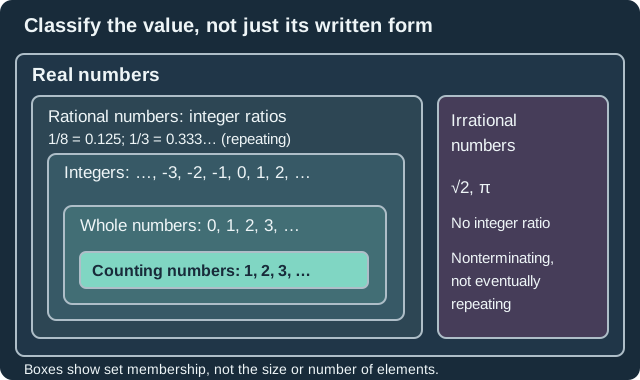
Use either all applicable categories or the most specific category, depending on the question. For example, 0 is whole, integer, rational, and real; its most specific set in this table is whole numbers.
Worked example: terminating and repeating decimals
An exact terminating decimal is rational: \(0.125=125/1000=1/8\). A negative terminating decimal is also rational: \(-1.75=-175/100=-7/4\).
An eventually repeating decimal is rational too. For example, \(0.\overline3=1/3\) and \(0.1\overline6=1/6\). A decimal does not need to terminate to be rational.
A real number is irrational precisely when its decimal expansion neither terminates nor eventually repeats. A few displayed digits followed by an ellipsis do not establish that condition: without an exact definition or an indicated repeating pattern, the unseen digits are unknown.
Worked example: roots, fractions, and equivalent forms
Simplify the exact value before classifying it:
| Written value | Simplified value | Applicable categories |
|---|---|---|
| \(\sqrt{36}\) | 6 | Counting, whole, integer, rational, real |
| \(-\sqrt{36}\) | −6 | Integer, rational, real |
| \(12/4\) | 3 | Counting, whole, integer, rational, real |
| \(\sqrt{49/81}\) | \(7/9\) | Rational, real |
| \(\sqrt2\) | Exact nonsquare root | Irrational, real |
| \(0\) | \(0/1\) | Whole, integer, rational, real |
Not every square root is irrational. A square root of a nonnegative integer is rational when that integer is a perfect square, and irrational otherwise. This statement is about integer radicands; do not apply it blindly to every written radical.
In real-number arithmetic, \(\sqrt{-9}\) is not defined as a real number. It is not an example of an irrational real number. Also, \(5/0\) is undefined, not rational or irrational.
Exact numbers versus rounded approximations
The exact \(\sqrt2\) is irrational, but the terminating decimal 1.414 is rational: \(1.414=707/500\). The relationship is \(\sqrt2\approx1.414\), not equality.
Similarly, \(\pi\) is irrational, while \(22/7\) is rational and is only an approximation to \(\pi\). A calculator's finite display does not change the exact number's classification.
Connect the two parts of the lesson
For \(\frac12x+\frac14x\), the rational coefficients add to \(\frac34\), giving \(\frac34x\). If \(x=4\), the evaluated value is 3, a counting number. If \(x=\sqrt2\), the value is \(\frac34\sqrt2\), which is irrational: if that value were rational, multiplying it by \(4/3\) would make \(\sqrt2\) rational, a contradiction.
An expression with a variable is not automatically an integer or irrational number. Its numerical classification depends on the assigned values unless its simplification fixes the value, as in \(5x-5x+7=7\).
Common mistakes
- Combining different exponents: x and x squared are not like terms.
- Dropping negative coefficients: Include each term's sign when grouping.
- Adding exponents when adding terms: \(x^2+x^2=2x^2\), not \(x^4\).
- Missing implicit coefficients: x has coefficient 1 and −x has coefficient −1.
- Combining before distributing: Expand grouped expressions carefully first.
- Assuming fractions cannot be integers: \(12/4=3\).
- Calling every endless decimal irrational: Repeating decimals are rational.
- Classifying by a rounded display: Exact values and their approximations can belong to different sets.
- Treating number categories as all mutually exclusive: Integer membership also implies rational and real membership.
- Calling undefined expressions irrational: Division by zero and negative square roots in the real system are not irrational real values.
Check your understanding
These independently written self-checks do not change the separate Quizzes or Practice tabs. For classification questions, use the convention and categories stated above.
- Group the like terms in \(4x^2-3x+7+2x^2+x-5\).
- Simplify that expression.
- Simplify \(-x+6x-2\).
- Simplify \(\frac23y-\frac16y+4\).
- Simplify \(2(x+5)-3(x-1)\).
- Simplify \(4ab-2ba+3a\).
- Give all applicable categories for \(-8\), 0, and \(\sqrt{16}\).
- Classify the exact \(0.\overline7\) as rational or irrational, and write it as a fraction.
- Classify \(\sqrt7\) and its approximation 2.646 separately.
- Explain why \(18/6\) is both rational and a counting number.
- Evaluate \(3x-3x+2\) for \(x=\sqrt2\), then classify the result.
- Are \(1/0\) and \(\sqrt{-4}\) irrational real numbers? Explain.
Answers and explanations
- Groups: \(4x^2\) with \(2x^2\); \(-3x\) with x; 7 with −5.
- \((4+2)x^2+(-3+1)x+(7-5)=6x^2-2x+2\).
- \((-1+6)x-2=5x-2\).
- \((\frac46-\frac16)y+4=\frac12y+4\).
- \(2x+10-3x+3=-x+13\).
- \(ba=ab\), so \(4ab-2ab+3a=2ab+3a\). The a term cannot join the ab terms.
- −8: integer, rational, real. Zero: whole, integer, rational, real. \(\sqrt{16}=4\): counting, whole, integer, rational, real.
- Rational: \(0.\overline7=7/9\).
- \(\sqrt7\) is irrational and real. The exact terminating decimal 2.646 is rational and real; it is not equal to \(\sqrt7\).
- \(18/6=3\), a positive integer count; it is also an integer ratio with nonzero denominator.
- The x terms cancel, leaving 2: counting, whole, integer, rational, real. An irrational input need not produce an irrational output.
- No. \(1/0\) is undefined, and \(\sqrt{-4}\) has no real value; neither belongs to the irrational real-number set.
Key takeaway
Combine only matching variable parts by adding signed coefficients; do not change their exponents. To classify a numerical value, simplify its exact form first and report the appropriate memberships. Terminating and eventually repeating decimals are rational; irrational real numbers neither terminate nor eventually repeat. Keep exact values separate from approximations and undefined expressions.
Related lessons
- Variables and Algebraic Expressions: terms, coefficients, and evaluation
- The Distributive Property: expand before combining terms
- Commutative, Associative, and Identity Properties: regroup signed terms correctly
- Converting Fractions and Decimals: exact terminating and repeating forms
- Perfect Squares and Square Roots: simplify roots before classifying
- The Number Line and Absolute Value: locate signed real values
Sources and authorship
The publicly accessible educational resources below were consulted for topic coverage and mathematical checks. This lesson's explanations, example settings, tables, self-checks, and number-set diagram were independently created; source prose, exercises, and artwork are not reproduced. Public access does not imply unrestricted reuse: check each resource's current license before reproducing material.